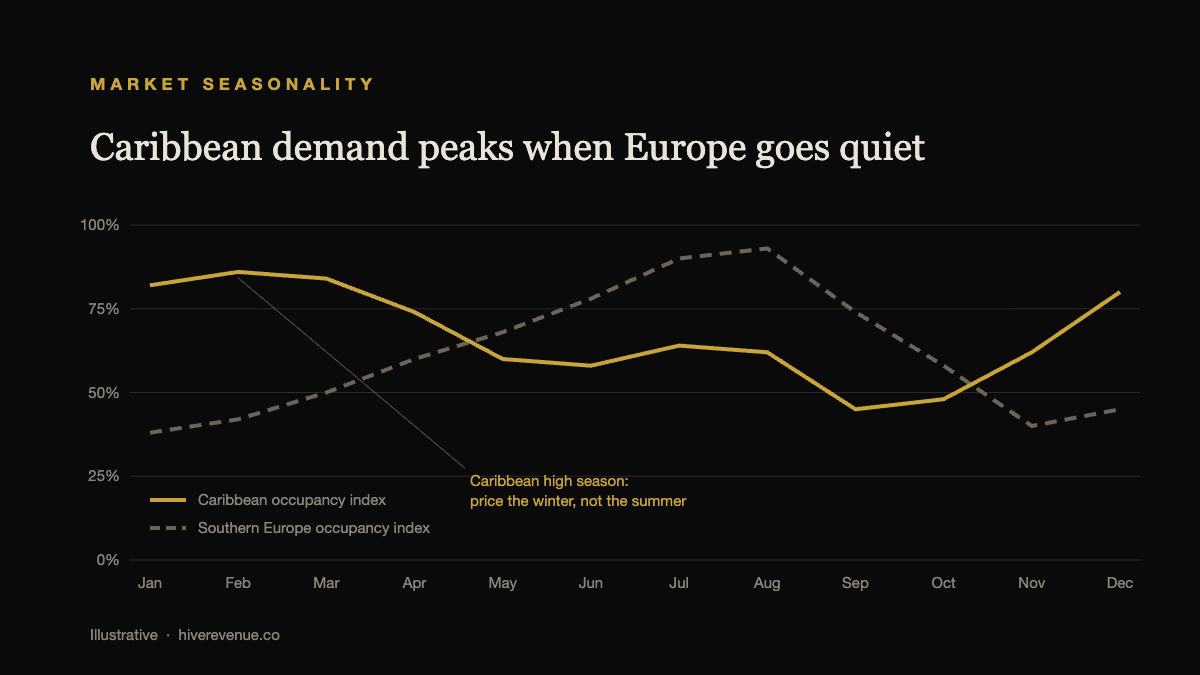
Most operators who own property in both Europe and the Caribbean make the same mistake. They plug Caribbean listings into PriceLabs, apply the same base price logic and minimum stay rules they use in Mallorca or the Algarve, and then wonder why their revenue curve looks nothing like their projections. The tools are not the problem. The mental model is.
European STR markets are built around a summer peak that compresses into 8 to 14 weeks, with shoulder seasons that reward aggressive discounting or hold strategy depending on destination. The Caribbean inverts almost everything about that logic. Seasonality flips. Guest profiles shift. The comp-set behaves differently. And the platforms do not always surface that to you cleanly.
If you are managing Caribbean inventory with a European-trained eye, some of your instincts are transferable. But some of them are quietly costing you money every single week of the year.
Seasonality Runs in the Opposite Direction
In Ibiza or Tuscany, your summer is your everything. You build the entire year around July and August, protect your peak with long minimum stays and aggressive rate floors, and accept that November through March will be slow or closed entirely. That framework is intuitive once you have lived through a European high season.
In Aruba or the Dominican Republic, the peak is December through April. The US and Canadian market drives this. Families escaping winter, couples running from grey skies. That demand is real, it is bookable far in advance, and your window to capture it at premium rates is shorter than it feels. June through October is low season, and in many parts of the Caribbean that means hurricane exposure, humidity, and a guest profile that is almost entirely deal-seekers.
What this means in practice is that the psychological peak, the weeks that feel most important to operators, are the weeks everyone else also knows are premium. Your comp-set is pricing up in January. Your guests are booking in October and November for those weeks. If you are still thinking about lead time the way you do in Barcelona, where last-minute summer bookings are common from European travellers, you will underprice your December inventory while it is still wide open.
Caribbean high-season inventory needs to be priced for its booked value in early autumn. Most operators are not doing that.
The Guest Profile Does Not Behave Like a European Traveller
European STR guests, broadly, are price-sensitive, plan ahead for peak, and book last-minute for shoulder. They are comparison shoppers who will read every review and scrutinise your photos. They book for 7-night stays because that is how European holiday culture works, Saturday to Saturday, school calendars, ferry schedules.
The North American guest driving Caribbean demand is different. They are often booking shorter stays, 4 to 6 nights, because they are working around long weekends and holiday blocks. Presidents’ Day week in Aruba is a legitimate demand event. Spring break is not one week, it is a rolling 5-week window that different school districts fill differently. Thanksgiving week in the Dominican Republic fills hard and fast.
This has direct implications for your minimum stay settings. The 7-night minimum that makes sense in Mallorca will kill your occupancy in Punta Cana during the shoulder weeks between holiday blocks. A 4-night minimum, or even 3 nights with a gap-fill rule, will outperform a rigid weekly structure in most Caribbean markets. PriceLabs handles this through custom minimum stay rules and orphan day logic. If you have not configured that specifically for North American holiday patterns, you are leaving filled gaps on the table.
The guest profile also affects your review dynamics. North American guests rate differently than European ones. They are faster to leave reviews, more likely to rate on cleanliness above all else, and more sensitive to air conditioning failures than to a missing beach umbrella. Your operational priorities need to reflect that.
Comp-Set Dynamics Are Harder to Read
In a mature European market like the Costa Brava or the Algarve, your comp-set is relatively stable. The all-inclusive hotel product exists but competes in a separate lane for most STR guests. The villas are competing with villas. You can track your neighbours in Key Data or Wheelhouse and get a reasonably accurate read on where the market is moving.
The Caribbean comp-set is noisier. All-inclusive resorts in Punta Cana or Aruba are directly competing with your private villa or apartment for the same North American family. When a large resort runs a January flash sale at $180 per person per night all-in, it affects your conversion rate even if you never see it in your STR market data. Wheelhouse and Beyond Pricing are not capturing that signal. Key Data can show you STR market trends but will not tell you that the Marriott just dropped rates for the first two weeks of March.
You have to hold the all-inclusive sector in your head as a parallel competitor and adjust your value positioning accordingly. This means leaning harder into what the resort cannot offer: kitchen access, private pool, flexibility, the experience of living in a place rather than being processed through one. That positioning has to be active in your listing copy, your direct booking site, and your pricing logic. A property that reads like a hotel room will get compared to hotel room pricing.
Read how the comp-set conversation fits into a full revenue review in the 42-point revenue audit framework.
What Actually Transfers From European Markets
Rate discipline during peak holds. If December through April is your high season, you protect it with the same rigour that a Ibiza operator protects July. You do not discount peak. You do not drop your minimum stay to fill one orphan night in the middle of Presidents’ Day week. You hold, and you let the market clear.
The direct booking argument is even stronger in the Caribbean than in Europe. OTA fees eat a larger share of your effective rate at price points common in Aruba and Turks and Caicos. A guest paying $600 a night for a villa is worth converting to direct. The direct bookings framework built for European markets applies cleanly here: email capture, retargeting, a booking engine on Lodgify or Hostaway, and a small incentive for returning guests.
The fundamentals of dynamic pricing tool configuration also transfer. The errors operators make in PriceLabs in Spain are the same errors they make in Caribbean markets: base prices set too low, minimum price floors that do not reflect true cost, and market data weights that overindex on last-minute comps. The PriceLabs settings post applies to Caribbean inventory without much adaptation.
What does not transfer is the instinct that low season means low minimum stays and heavy discounting. In a European market with a genuine shoulder demand pool, that logic works. In a Caribbean low season during hurricane months, the question is not how much to discount. It is whether to operate at all, and what guest profile you are actually targeting if you do. A digital nomad programme or a monthly rental agreement will outperform a discounted short-stay strategy in June and July in most Caribbean markets.
Tool Configuration for Caribbean Inventory
If you are running PriceLabs across a mixed portfolio that includes both European and Caribbean properties, the first thing to confirm is that your market data source is correctly assigned. PriceLabs pulls comp-set data by market. A property in Aruba pulling from a thin or misconfigured market reference will price against the wrong set of comps entirely.
Beyond Pricing has reasonable Caribbean market coverage for major islands. Wheelhouse tends to perform better in North American resort markets generally, and the Caribbean sits closer to that context than to the European one. If you are choosing between them for a Dominican Republic or Aruba property, Wheelhouse is worth testing. See the full comparison in the PriceLabs vs Wheelhouse vs Beyond post, keeping in mind that the European market conclusions do not map directly.
Custom date overrides matter more in Caribbean markets because the holiday calendar is different and the tools do not always weight North American holidays correctly. Presidents’ Day, Memorial Day, Labor Day, Thanksgiving. These need manual review every year. Do not assume the algorithm sees them with the same clarity it sees Christmas.
Most operators set their Caribbean pricing once and check it quarterly. The operators who outperform are reviewing weekly during peak season and adjusting their date-level overrides every two to three weeks. That cadence is not optional if you are serious about the market.
Run the Audit on Your Caribbean Portfolio
The Hive Method Workbook includes the 42-point revenue audit, a direct booking readiness scorecard, and a 90-day execution plan. Just $45 — built for European STR operators running 1 to 10 properties.