Most hosts read reviews the way students read a graded exam. Check the score, skim for anything painful, feel good or bad about it, move on. That is a waste of the single best piece of market research you own.
Your reviews are hundreds of guests telling you, unprompted and in their own words, why they picked you and what they loved. That is a marketing brief. Read properly, it tells you who to target, what to say to them, and which dates to aim them at. In this post I will show you how to mine reviews for guest interests, turn the patterns into campaigns, and I will run the math on one that beats a blanket discount by about €7,500 in a single shoulder season.
Why reviews beat every persona workshop you have ever sat through
Ask a property manager who their guest is and you will hear something like “families and couples, mostly European.” That is true and completely useless for marketing. You cannot write an ad for “families and couples.”
Reviews are different because guests volunteer the detail that matters. Nobody writes “we are a couple.” They write “perfect base for our golf week, twenty minutes to three courses.” Or “the desk and the fast wifi saved my work trip.” Or “grandma loved that the bedroom was on the ground floor.” Every one of those sentences is a segment, a message and a selling point in one line, written by the customer.
The other advantage is honesty at scale. One guest mentioning golf is an anecdote. One hundred and twenty guests mentioning golf out of nine hundred reviews is a market you are already serving without trying.
How to mine your reviews in an afternoon
You do not need a data team for this. You need an export and a bit of patience.
1. Pull everything into one sheet. Most PMS platforms let you export reviews across Airbnb, Booking.com and Vrbo, or you can copy them from each channel. You want review text, rating, listing, and stay dates. Two years of history is ideal because it catches seasonality.
2. Tag themes. Start with a keyword list per theme: golf, beach, work or wifi or desk, dog or pet, wedding, anniversary or honeymoon, grandparents or accessible or ground floor, crib or toddler or high chair, hiking, surf. An LLM can do this in minutes if you paste the reviews in batches and ask it to return one row per review with theme tags. Either way, spot check fifty rows by hand. Keyword tagging will happily count “we did not need the crib” as a toddler family.
3. Count and cross reference. For each theme, count mentions, then look at three things: which listings attract it, which months those stays happen in, and the average rating of those reviews. A theme that shows up at 4.9 is a strength to sell. A theme that shows up at 4.3 is a product problem to fix before you spend a cent advertising it.
4. Match themes to soft dates. This is the step everyone skips, and it is the one that makes money. A theme only earns its keep when it points at a group that will travel on dates you struggle to fill.
What the patterns usually look like
After running this for portfolios in Spain, Portugal and the Caribbean, a few themes come up again and again.
Remote workers. Mentions of desks, wifi speed and quiet usually cluster in longer stays outside school holidays. They are a natural fit for your 7 to 28 night length of stay discounts and for midweek gaps in low season.
Dog owners. If you allow pets, reviews mentioning dogs tend to come with longer stays and stronger ratings, because pet friendly supply is thin. That scarcity is worth rate, not a discount.
Event and occasion guests. Weddings, anniversaries and birthday trips show up as clusters around specific venues or dates. They book early and they book in groups, which makes them perfect for multi unit campaigns.
Activity travelers. Golf, surf, hiking and diving guests are gold in shoulder season, because their activity is often better when the beach crowd has gone home.
A worked example: golf in the Algarve
Here is an example based on a real portfolio, with numbers rounded and the client anonymised. A 30 unit portfolio in the Algarve exported 900 reviews from the last 24 months. Golf came up in 124 of them, about 14%. Those reviews averaged 4.91 stars, and 71% of the golf stays landed in February, March, October and November. Twelve of the 30 units, all within fifteen minutes of a course, accounted for almost all of them.
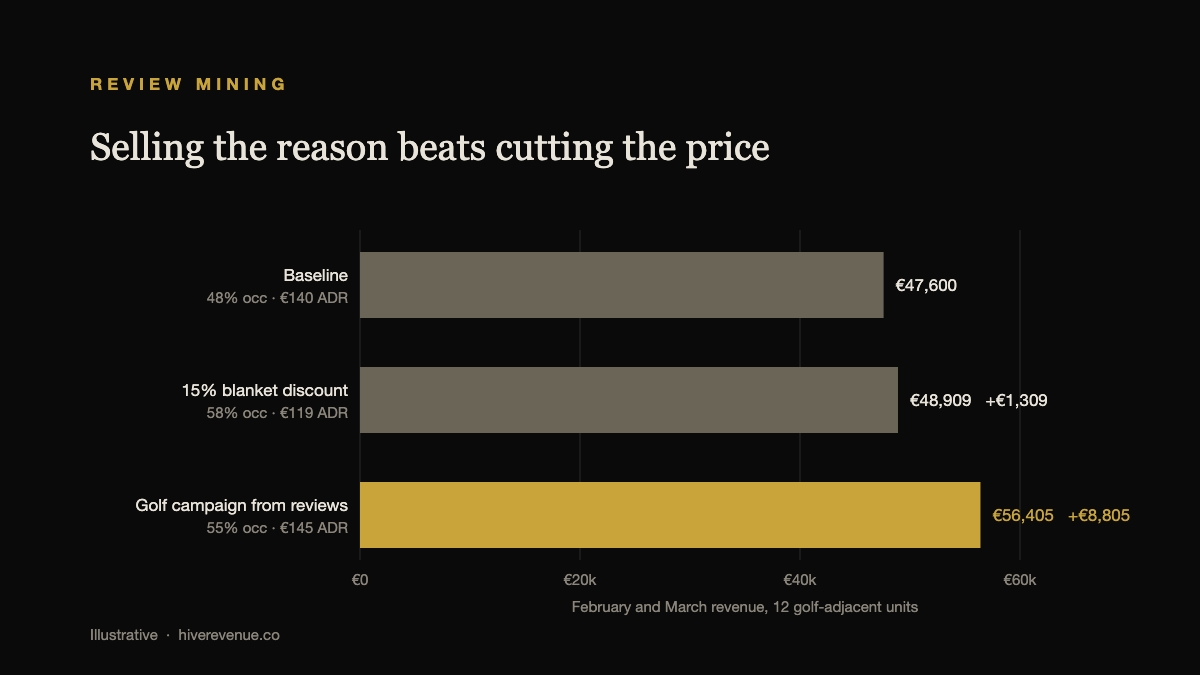
February and March were the soft spot. Those 12 units had 708 available nights across the two months (12 units times 59 nights), running at 48% occupancy and an ADR of €140.
Baseline: 708 × 48% = 340 nights. 340 × €140 = €47,600.
The owner’s instinct was the usual one: drop rates 15% across both months. Say that pushes occupancy to 58%. Blanket discount: 708 × 58% = 411 nights at €119 = €48,909. That is €1,309 more revenue for 71 more nights of cleaning, wear and guest messaging. Barely worth the laundry.
Instead we built a golf campaign. A landing page for the 12 units, written using phrases lifted straight from the reviews (“three courses within twenty minutes,” “room for two golf bags,” “early breakfast on the terrace before tee time”). Listing titles and first photos updated to show club storage and course proximity. A small paid campaign targeting golf travelers from the UK, Ireland and the Netherlands. A re-engagement email to past direct guests who had opted in, and a partner deal with two local courses for a tee time perk. Total cost: about €1,200.
Because the campaign sold a reason to stay rather than a lower price, we could hold rate and even nudge it. Say occupancy lands at 55% with ADR at €145. Targeted campaign: 708 × 55% = 389 nights at €145 = €56,405.
That is €8,805 above baseline, or €7,605 after the €1,200 spend. Compared with the blanket discount, the campaign made about €7,500 more while selling 22 fewer nights. Fewer turnovers, higher rate, and guests who already love what the property is good at.
The part I like most is what happens the following year. Those golf guests leave golf reviews, the theme gets stronger, and the campaign gets cheaper to run.
Mistakes that waste the whole exercise
Marketing a theme you do not deliver well. If your remote work reviews average 4.4 because the wifi drops every evening, the campaign will just produce more 4.4 reviews. Fix the router first, then advertise.
Chasing volume instead of dates. Your biggest theme might be beach families in August. You are already full in August. The theme worth money is the one that points at the dates you are discounting.
Using guest words carelessly. Paraphrase review language rather than publishing names, and only email past guests who gave you permission. In Europe especially, GDPR applies to your guest list, and OTA guest emails are not yours to market to.
Discounting anyway. The whole point of a targeted campaign is that the audience values something specific. If you pair it with a 20% promo out of nerves, you have paid twice for the same booking. Use a perk tied to the theme, like late checkout for golfers or a dog welcome kit, instead of a price cut.
Never measuring it. Tag campaign bookings with a promo code, a UTM link or a dedicated rate plan. Compare occupancy and ADR on the targeted units against similar untargeted units over the same dates. If you cannot separate the result, you cannot repeat it.
Your one hour version
Export the last 12 months of reviews. Tag them for five themes. Pick the theme with the highest rating that clusters in your weakest two months. Rewrite one listing title, one set of opening photos, and one short landing page in your guests’ own words, and point a small campaign at those dates. Hold rate and see what happens.
If you want help turning your review history into a campaign calendar, that is exactly the kind of thing I dig into in a Hive Revenue audit. Your guests have already written the brief. Somebody just has to read it.