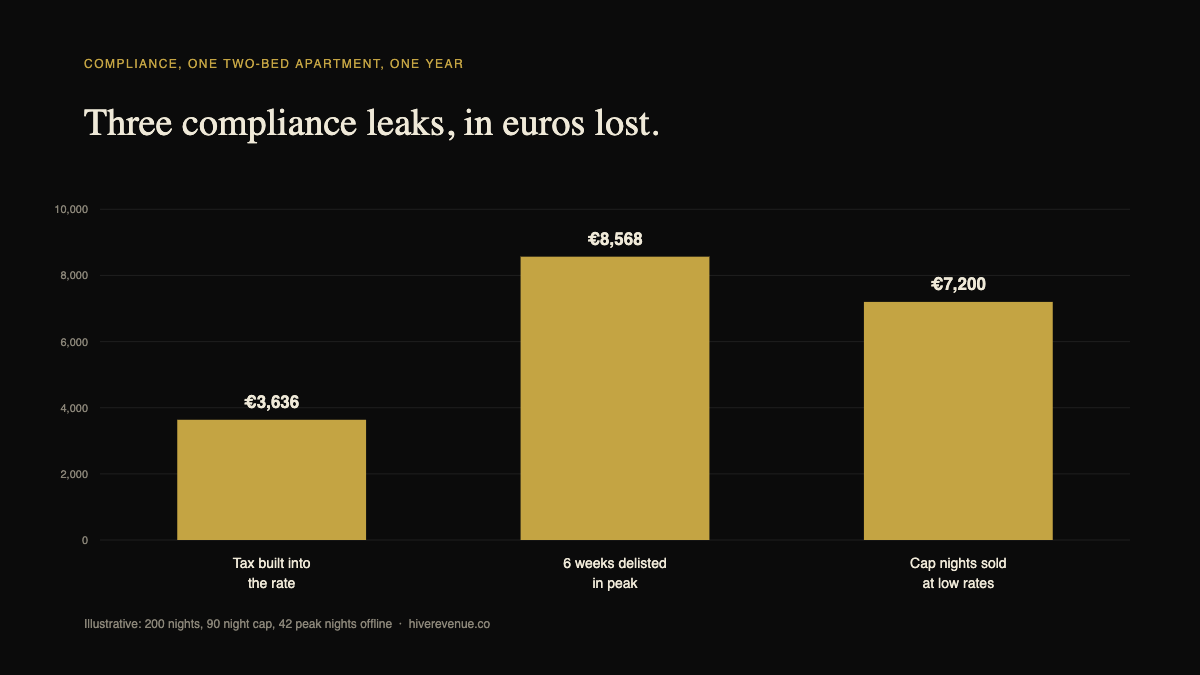
Most hosts treat compliance as the boring thing you do once so nobody fines you. I treat it as a revenue lever, because every rule in Europe and the Caribbean changes either how many nights you can sell, what you actually keep per night, or whether you are allowed on the shelf at all. This post walks through the three places compliance quietly eats revenue, with worked math, and what to do about each before your next pricing review.
Compliance decides whether you can sell at all
Start with the blunt one. In Spain, listings need a registration number to appear on the major platforms, and the platforms are now expected to remove the ones without it. Across the EU, the short-term rental regulation that began applying in May 2026 pushes in the same direction: a registration number per property, shown on the listing, with platforms sharing data with local authorities.
Rules differ by country and by town, and they change, so check the current local rule rather than trusting a blog post (including this one). The revenue point is simple: a delisting does not arrive on a convenient Tuesday in February. It arrives in the middle of your best weeks, because that is when a mismatched registration number gets noticed.
Here is a worked example. Take a two-bedroom apartment with an annual ADR of 180 euros and 65 percent occupancy. That is 365 x 0.65 x 180, or roughly 42,700 euros a year. Now say a missing renewal knocks the listing offline for six weeks in peak season. Peak occupancy is 85 percent and peak ADR is 240 euros. Six weeks is 42 nights, so you lose 42 x 0.85 x 240 = 8,568 euros. That is a fifth of the year, gone because of a form.
The fix is boring and cheap. Keep a compliance calendar next to your pricing calendar. Every registration, license renewal and insurance certificate gets an expiry date and a reminder 60 days ahead. If you manage properties for owners, put the renewal dates in your owner reporting so the owner sees you are protecting their revenue, not just chasing it.
Taxes change what you keep, so they change what you charge
The second leak is quieter. Tourist taxes, occupancy taxes and VAT treatment differ from one destination to the next, and the question that matters for pricing is whether the tax sits on top of your rate or inside it.
Say you list at 200 euros and the local tax is 10 percent. If the tax is added on top, the guest pays 220 and you keep 200. If your channel or your local rules treat the 200 as tax inclusive, you keep 200 / 1.10 = 181.82 euros. That is 18.18 euros a night. Over 200 booked nights it is 3,636 euros a year, from a rule you never negotiated.
Hosts miss this in two ways. They copy a rate from one island or country to another without checking how tax is shown, and they compare channels without noticing that one displays tax inclusive prices and another does not. A guest sees 200 on one site and 220 on another and decides you are expensive, when you are actually the same. This is the same trap I wrote about in the rate parity post: parity is the same deal everywhere, not the same number everywhere.
The Caribbean makes this sharper. Islands often stack a government tax, a service charge and sometimes a resort fee, and the mix varies by island and by property type. Before you set a rate for a new island, write down the final all in price the guest sees and the amount that actually reaches you. Price from the second number, then check the first against your comp set.
What to do: build a small table for every market you operate in with the headline rate, every tax and fee, the all in guest price, and your net. Update it when rules change. Let your pricing tool work off the net, not the sticker.
Night caps turn pricing into an auction for your best dates
The third leak is the most interesting. In places with an annual night cap, such as the 90 night limit I covered in the France post, you do not have unlimited inventory. You have 90 nights to sell, and the job flips from filling the calendar to choosing the right 90 nights.
Same apartment. If you let the nights fill whenever they come, you might sell 90 nights at an average of 180 euros. That is 16,200 euros. If instead you block the shoulder season, hold out for peak weeks and weekends, and average 260 euros, the same 90 nights bring in 23,400 euros. The 7,200 euro difference comes entirely from choosing which nights to sell.
This changes your settings. Raise your base and minimum price so that low value dates are not sold cheaply, widen your orphan gap rules so a short gap does not eat a cap night, and lengthen your minimum stay on high demand dates so each cap night is part of a longer, more profitable booking. Treat each night like a seat on a plane with limited capacity: the cheapest seat should be the last one you are willing to sell, not the first.
Not every market has a cap, but many have some form of limit: a licensed number of rental days, a seasonal permit window, or a rule that only certain building types qualify. Ask which of those applies to you before you open the pricing tool, not after.
Put it in the pricing review
Here is the routine I use with owners. It takes about twenty minutes a month and it keeps compliance in the same conversation as revenue.
First, list each property with its registration status and the next renewal date. Anything inside 60 days gets a task and an owner.
Second, confirm tax treatment per channel. For each property, write down the net you keep per night on each channel at the current rate. If the nets differ by more than a couple of percent, decide whether that is a pricing decision or an accident.
Third, for any market with a cap or a permit window, calculate the revenue per allowed night and compare it to your current average. If your average is below your target, move your base and minimum prices up before you chase occupancy.
Fourth, tell the owner. People are more comfortable with higher minimums and stricter minimum stays when they understand the cap is the constraint, not your caution. The number that persuades is net revenue per allowed night, not occupancy.
A short closing checklist
Compliance will never be exciting, but it is one of the few places where careful admin pays directly into revenue. Do these this week: put every renewal date on a calendar, write the net per night for each channel, and for any capped market, calculate what each allowed night earns. If one of those three numbers surprises you, you just found money.
Rules change, so confirm the details with your local authority or a licensed adviser before you act on any of the numbers above. They are illustrations of how the math works, not legal advice.