Most hosts treat their review score as a trophy. It is closer to a price tag. A listing sitting at 4.5 stars in a market full of 4.8s is being quietly marked down by every guest who scrolls past it, whether you mark it down yourself or not. The only question is whether you control the discount or the algorithm and the guests do it for you.
This post gives you a simple rule for pricing your reputation: measure your score against your market median, discount deliberately until you reach it, and then charge a premium once you own the top of the ladder. There is a worked example with real math below, so you can see what a few tenths of a star are worth in dollars.
Your score only means something next to your neighbors
A 4.6 sounds fine. In a market where the median active listing is a 4.6, it is fine. In a market where the median is 4.85, it is a red flag. Guests do not evaluate your rating in isolation. They open six tabs, line up six listings, and the one with the lowest number gets eliminated first.
That is why the first step is boring and useful: pull the review scores for your comp set and find the median. Not the average, because one new listing at 5.0 with two reviews will distort it. Take the median of listings with at least 20 reviews, since those are the ones guests actually trust.
Then place yourself in one of three zones:
- Below the median by 0.2 or more. You are paying a reputation tax. Price below the market until you close the gap.
- Within 0.1 of the median. You are a peer. Price at the market and compete on photos, amenities, and fit.
- Above the median by 0.1 or more, with 40 or more reviews. You own the top of the ladder. Price above the market and hold the line.
Why a lower rate is the cheapest way to buy better reviews
Here is the part that feels backwards. When your score is below market, raising your rate does not protect your revenue. It narrows your pool of guests to people who are comparing you on price, and those guests are the least forgiving. A guest who paid a premium for a 4.5 will notice every scuffed baseboard.
A guest who got a really good deal tends to grade on a curve. They notice the value, they overlook small things, and they leave 5 stars. A modest discount is, in effect, a review acquisition budget. You are paying for the 5-star stays that pull your average up.
This only works if the product is sound. If your 4.5 comes from a broken hot tub and a smell in the hallway, discounting will just fill the calendar with disappointed guests. Read your last ten three-star and four-star reviews first. If the complaints are fixable, fix them while the discount does its work. If they are structural, such as noise from the street, price for that reality instead.
A worked example: the 4.5 versus the 4.8 market
Take a two-bedroom condo in a beach market. The comp set median is 4.8 stars, and the market ADR for a comparable two-bedroom is $220. Your unit sits at 4.5 with 38 reviews.
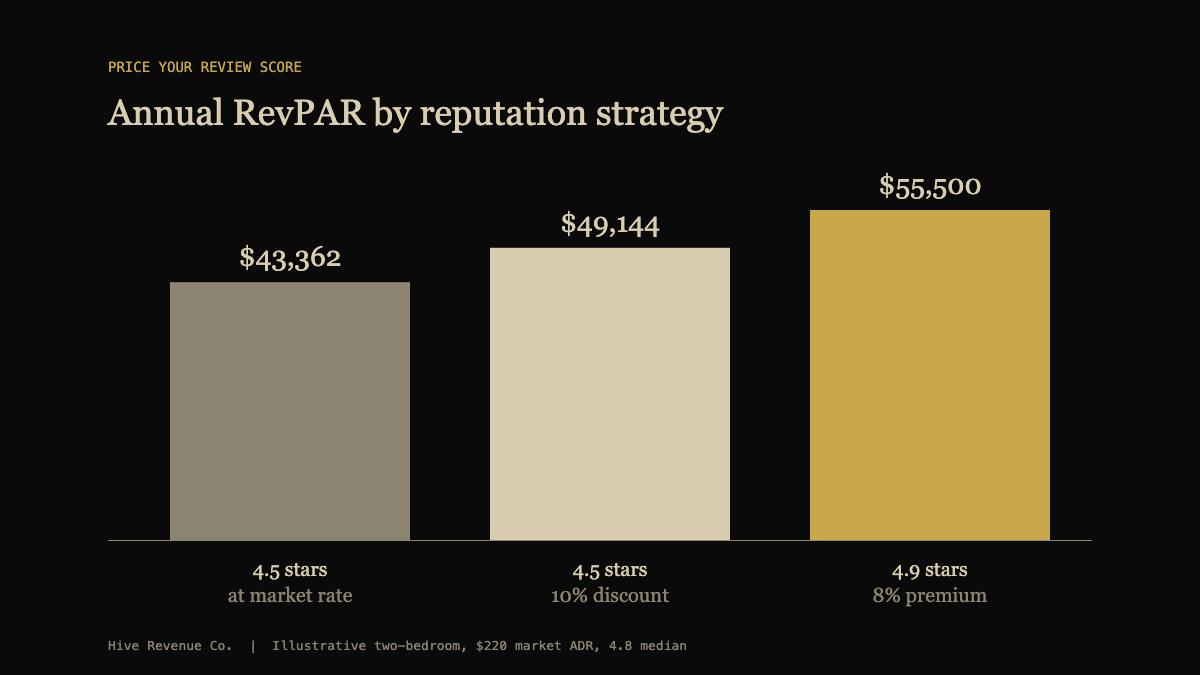
Scenario A: price at the market. You hold $220 because that is what the comps get. Because you are the lowest-rated listing in the set, occupancy runs at 54 percent. RevPAR is $220 x 0.54 = $118.80, which is about $43,362 over a year.
Scenario B: discount 10 percent. You price at $198. The deal pulls in more bookings and occupancy rises to 68 percent. RevPAR is $198 x 0.68 = $134.64, which is about $49,144 over a year. That is roughly $5,780 more than Scenario A, from charging less.
The bigger prize comes next. Suppose the discounted stays are happy ones. Over the following year you collect 45 new reviews, mostly 5 stars, and your average moves from 4.5 to 4.8. You now match the median, and you can drop the discount.
Scenario C: you reach 4.9 and charge for it. After another stretch of strong stays you hold 4.9 with 90 reviews, above the 4.8 median. You price 8 percent over the market at $237.60. Occupancy settles at 64 percent, a few points below the discount years, because you are asking more. RevPAR is $237.60 x 0.64 = $152.06, which is about $55,500 a year.
Line the three years up and the pattern is plain. Holding the market rate with a weak score earned about $43,400. The deliberate discount earned about $49,100. The premium on a strong score earned about $55,500. You are $12,000 a year ahead of where you started, and the owner got there by trusting a lower rate for a season. These numbers are illustrative, so use your own comp set, but the shape holds up across markets: the discount pays for itself, then the premium pays you back.
How to run the discount without wrecking your calendar
A reputation discount is not a permanent sale. Treat it like a project with a start, a target, and an end.
Set the discount as a percentage off the recommended rate in your pricing tool, not as a hardcoded base price. In PriceLabs that is a customization at the listing or group level, and in Wheelhouse it is a similar adjustment on your base. That way the discount scales with seasonality, so you are not accidentally giving away 10 percent in a sellout week when you could have charged full freight.
Apply it hardest where reviews are cheapest to win: midweek and shoulder dates, where guests are flexible and the stay is low stakes. Keep peak weekends closer to market, since those guests have the highest expectations and the most to be disappointed about.
Set the exit rule on day one. A good one: when the rolling 12-month score reaches within 0.1 of the market median with at least 30 reviews in the window, step the discount down by 3 points per month until you are at market. Writing that rule down stops the discount from becoming a habit.
Charging the premium once you have earned it
The upside is easy to leave on the table. Plenty of managers hit a 4.9, feel relief, and keep pricing like it is 4.5. Guests will pay for proof. A listing at the top of the ladder can usually ask 5 to 10 percent over comps without losing much occupancy, because it is the safe choice in a set of choices.
Raise in steps of 2 to 3 percent and watch your pickup for two or three weeks after each step. If pace against last year holds, keep going. If you see bookings stall while comps keep filling, you went one step too far, so back off by one.
One more thing for the owner conversation: a premium is fragile. One bad month can pull a 4.9 down toward 4.8 and take the premium with it. This is a good reason to put money into the things that protect your score, like a deep clean between stays, a quick fix when a guest reports a problem, and a message at the right moment to head off a bad review.
What to do this week
Pull the review scores for your comp set, drop anything under 20 reviews, and find the median. Compare it with your own score. If you are 0.2 or more below, set an 8 to 10 percent discount as a percentage adjustment, concentrate it on midweek and shoulder dates, and write the exit rule before you save the setting. If you are above the median with 40 or more reviews, test a 3 percent increase and watch the pace for two weeks. Either way, your review score is already in your price. You are just choosing whether to set it on purpose.