Every market has a handful of weekends where the usual rules stop working. A conference lands, a marathon fills the streets, a festival announces its lineup, and suddenly every comparable listing within two miles is gone. Dynamic pricing tools see the demand spike and push your rate up. The question nobody asks is whether they push it far enough, early enough, and with the right guardrails.
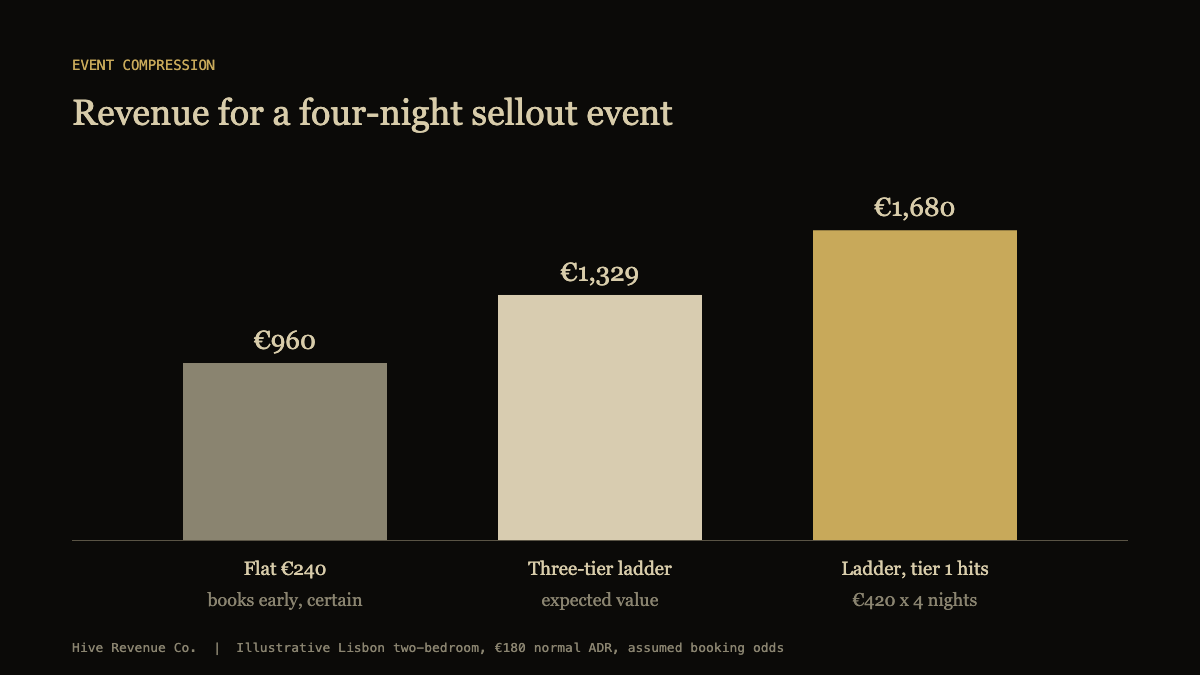
This post is about event compression: what it is, how to spot it before your tool does, and a simple tiered approach that beat a flat event rate by 38 percent in the worked example below.
What event compression actually is
Compression is what happens when demand for a set of dates exceeds the supply of rentable nights in a market. Hotels fill first, then the better vacation rentals, then everything else. Once the market is compressed, guests stop shopping on price. They shop on availability. If your listing is open, it gets booked, and the only question is how much you were paid for it.
The trap is that compression does not feel like an emergency from the inside. Your calendar looks normal. Your occupancy is normal. The only difference is that your competitors are quietly disappearing from search results, and every night they vanish makes your open dates worth more.
A sellout event is not just a high-demand weekend. It is a weekend where the market’s supply is the constraint. That changes how you should price it, because demand stops being the number to chase and scarcity becomes the number to protect.
How to see compression coming
Most tools flag events after the demand shows up in booking data. By then you have already sold some of your best nights at ordinary prices. You want to find compression yourself, four to ten weeks out. Three signals matter.
First, forward occupancy for your comp set. If the dates are normally sitting at 30 percent booked six weeks out and they are at 60 percent, the market is telling you something. A reading of 50 percent or more above the same lead time last year is the point where I stop treating the dates as normal.
Second, the disappearance rate. Open a search for your area on the event dates, two guests, no filters. Count the listings that show as available. Check again in a week. If availability drops by a third in seven days, you are watching compression build in real time.
Third, hotel pricing. Hotels run their own yield systems and tend to react quickly. When a mid-range hotel that normally charges 140 euros asks 320, the event is real, and vacation rentals that sleep four can often price at a premium to the hotel room because they offer more space per guest.
Write these numbers down once a week for any date range you suspect. Three data points make a trend, and a trend is what lets you move before the market does.
The flat-rate mistake
Here is how most owners handle a sellout event. They look at what the tool recommends, perhaps add a little, and leave it. The listing books early at a good-looking number, and everyone feels smart.
The problem is that the first booking is also the cheapest one. A guest who books ten weeks out for a compressed weekend has the least information and the most time to find alternatives, so they are the most price sensitive buyer you will meet. The guests who arrive at three weeks and one week out have fewer options and less patience. They will pay more, if you are still available.
Selling out early at 240 euros feels like a win until you learn that the dates would have cleared at 360 euros two weeks later.
A worked example: four nights in Lisbon
Take a two bedroom in Lisbon with a normal ADR of 180 euros. A four night conference weekend is coming up, and your comp set is already 58 percent booked at eight weeks out against a usual 30 percent.
Option A, flat rate. You set 240 euros, a 33 percent premium over normal, and let it ride. It books early, as a four night stay. Revenue: 4 nights x 240 = 960 euros. It is certain, and it is clean.
Option B, a three step ladder. You publish at 420 euros a night with a four night minimum, then step down on a schedule if it stays open:
- Tier 1, from now until 21 days out: 420 euros, four night minimum.
- Tier 2, from 21 to 7 days out: 360 euros, four night minimum.
- Tier 3, from 7 days out until arrival: 300 euros, three night minimum.
Assume these booking probabilities, which are illustrative and based on how compressed markets usually behave:
- 35 percent chance it books at tier 1: 4 x 420 = 1,680 euros.
- Of the remaining 65 percent, half book at tier 2: 0.65 x 0.50 = 32.5 percent, paying 4 x 360 = 1,440 euros.
- Of the remaining 32.5 percent, 70 percent book at tier 3: 0.325 x 0.70 = 22.75 percent, paying 4 x 300 = 1,200 euros.
- The last 9.75 percent stays open and you release it at normal rates for whatever short stays you can land.
Expected revenue: (0.35 x 1,680) + (0.325 x 1,440) + (0.2275 x 1,200) = 588 + 468 + 273 = 1,329 euros. That is 369 euros more than the flat rate, a 38 percent lift, before counting anything you recover from the unsold 9.75 percent.
Notice what the ladder is not. It is not a bet that the highest price always wins. In roughly one case in ten, the dates do not sell at the premium, and you are the one holding the risk. The point is that the expected value is higher, and the downside is bounded by a floor you set in advance.
Guardrails that keep the ladder honest
A ladder is only as good as the rules around it. Before the first night is priced, decide the following.
Set the floor first. Your lowest tier should never go below the point where you would rather hold the dates for a late short booking. For most operators that is still a healthy multiple of the normal rate, around 1.5 times ADR for a true sellout.
Use minimum stays as a pricing tool. A four night minimum on a four night event stops a guest from booking the Friday and Saturday and stranding your Thursday and Sunday. Relax it only at the last tier, when an orphan gap is better than an empty calendar.
Look at cancellations. Compressed markets generate speculative bookings, where guests reserve three places and cancel two. A stricter cancellation window for event dates, with a non-refundable rate at a small discount, protects the premium you worked for.
Check your own channel settings. A rate that is right on one site and stale on another is the fastest way to give away a sellout. Confirm every connected channel shows the ladder, not just your direct site.
What to do after the event
Treat each event as data. Within a week, record what you charged, when it booked, and what the market looked like at that moment. Next year the same event is a known quantity, and you will know how early the premium window opens and how far the market tolerated.
Also compare your result with the comp set. If you sold at tier 1 and the market sold out within days, you may have been too cheap. If you reached tier 3 and the market still had availability, your read was too optimistic. Either answer is useful.
Your short checklist
This week, list the five biggest demand dates in your market over the next six months. For each one, record comp set forward occupancy and how it compares with the same lead time last year. Pick the two that look compressed, and build a three tier ladder for each, with a floor, minimum stays, and a stricter cancellation policy. Put a reminder in your calendar at 21 and 7 days out, and write down what happened when the dates pass.
Sellout events are the closest thing short-term rentals have to a free lunch. The owners who take it are not guessing better. They are just starting earlier, and refusing to let the first booking set the price.