“Your guests would love a hot tub” is the weakest sentence in property management. Owners hear it as a request to spend $9,500 of their money so your listing photos look better. This post gives you a simple way to turn an amenity idea into a payback calculation an owner can say yes to in one email.
Why owners say no (and are usually right)
Most amenity pitches fail for a boring reason. They arrive as a feeling instead of a forecast. The manager says guests are asking for it, competitors have it, and reviews mention it. All true, none of it answers the only question an owner is asking: “When do I get my money back, and what if it doesn’t work?”
Owners are not hostile to spending. They renovate kitchens and buy new mattresses without blinking when someone shows them the logic. The problem is that an amenity feels like a bet with no odds attached. Your job is to attach odds.
There are three pieces to every honest amenity case: the lift you expect in rate, the lift you expect in occupancy, and the cost of owning the thing after the installer leaves. Skip any one of them and the owner will find the hole in about thirty seconds.
Step 1: Find the premium in your own market, not in a blog post
Do not quote an industry average that says hot tubs add 20 percent. That number is made of other people’s markets. Instead, pull your comp set and split it into two groups: units with the amenity and units without, matched on bedrooms and location.
Use a tool you already have. PriceLabs neighborhood data and Wheelhouse comp sets both let you filter by amenity. Compare forward ADR and last-year occupancy for the two groups. If the amenity group earns $340 and the non-amenity group earns $310, your market premium is $30, or about 10 percent. That is the number you take to the owner.
Then haircut it. A new amenity does not earn the full premium on day one, because it has no reviews mentioning it yet. Assume you capture about half the premium in the first season and the rest in year two. Owners trust a conservative number far more than an exciting one.
Step 2: Model the occupancy side separately
Amenities do two jobs. They let you charge more, and they let you win bookings you would have lost. A hot tub in a cold-weather market fills shoulder-season nights that used to sit empty. A pool in a hot market does the same in summer.
Estimate this from the gap between your occupancy and the amenity group’s occupancy in your slow months only. If your unit sits at 38 percent in November and the amenity comps sit at 52 percent, you have a 14 point gap to chase. Assume you close a third of it. That is a 4 to 5 point lift in those months, not a full-year miracle.
A worked example: the $9,500 hot tub
Here is a three-bedroom mountain unit, today and after the install. Numbers are rounded and the management fee is 20 percent of gross.
Before: 212 booked nights at a $310 ADR. Gross revenue is $65,720.
After (base case, first full year): occupancy rises from 58 percent to 60 percent, so 219 booked nights. ADR rises $30 to $340. Gross revenue is $74,460.
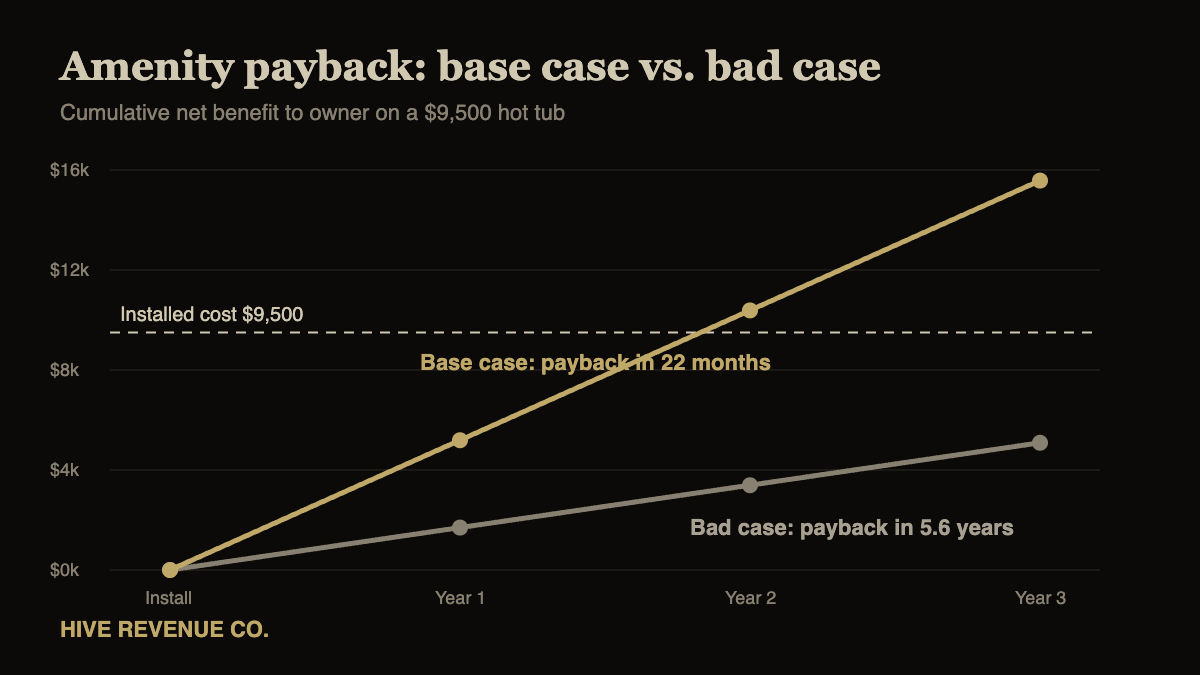
The gross lift is $8,740. After the 20 percent management fee, the owner keeps $6,992 of it. Now subtract the ownership costs most pitches forget: about $1,200 a year for chemicals, cleaning time, and the cover, plus $600 a year in added electricity. That leaves $5,192 of real annual benefit to the owner.
Payback on a $9,500 installed cost is 9,500 divided by 5,192, which is 1.83 years, or about 22 months. That is a number an owner can compare to the interest on their savings account, and it wins.
Always show the bad case
This is the step that turns a pitch into a decision. Cut the gross lift in half. Gross lift becomes $4,370, the owner keeps $3,496 after your fee, and after $1,800 of added costs the net benefit is $1,696 a year. Payback stretches to 5.6 years.
Say this out loud to the owner: “If it only performs half as well as the comps suggest, you get your money back in under six years, and the tub still adds resale appeal. If it performs as the comps suggest, you are whole in under two.” Owners relax when you show them the floor. Showing the floor is also what makes you the manager they keep.
The break-even question is just as useful. If the owner wants a two-year payback, the amenity needs to deliver about $8,190 of gross lift. Compare that to the comp premium and the owner can see how much margin for error exists.
Step 3: Pitch it in the owner’s language
Owners do not think in ADR. They think in “what lands in my account.” So translate every line. Lead with annual net benefit and payback in months. Put the ADR and occupancy assumptions in a small table underneath for anyone who wants to check your work.
Keep the email to one screen. A good structure looks like this: one sentence naming the amenity and cost, one sentence with expected annual net benefit, one sentence with the downside case, and one sentence with the decision you need and by when. Attach the model as a spreadsheet for the owner who likes to poke at it.
Timing matters too. Pitch in your slow season, install before your shoulder season, and be ready to price the new amenity from the first available night. Install in October and you have captured nothing before the holiday peak, which is the part of the model owners remember.
Step 4: Report back, every time
The pitch is half the job. Three months after the install, send the owner a one-page follow-up with actual ADR and occupancy against the base case, plus the review count mentioning the amenity. If you beat the base case, you have earned the next yes. If you missed, explain why and what you are changing. Owners forgive a miss they hear about from you. They do not forgive one they discover themselves.
This also improves your future forecasts. After two or three installs you will have your own market premium data, which is worth more than any comp set filter, and the next pitch writes itself.
Which amenities usually clear the bar
No amenity is automatically worth it, but some pencil out more often than others because they either lift rate, lift occupancy in slow months, or both. In many markets the strongest candidates are hot tubs in cold climates, pools in warm ones, an actual workspace for midweek stays, and sleeping capacity (a bunk nook that moves you from sleeps 6 to sleeps 8). The weakest are anything decorative. A $2,000 art wall rarely shows up in a payback model.
Capacity is worth special attention. Going from six to eight guests changes which searches you appear in, and groups pay for space. Check how many comps in your area sleep eight before you assume it will help.
Your action list
Pick one unit and one amenity this week. Pull the comp split, apply the half-premium haircut, build the base and bad cases, and send one screen of email. If the numbers do not clear a three-year payback even in your base case, tell the owner not to buy it. That honesty is the most valuable thing you will do all quarter, because the next time you say yes, they will believe you.