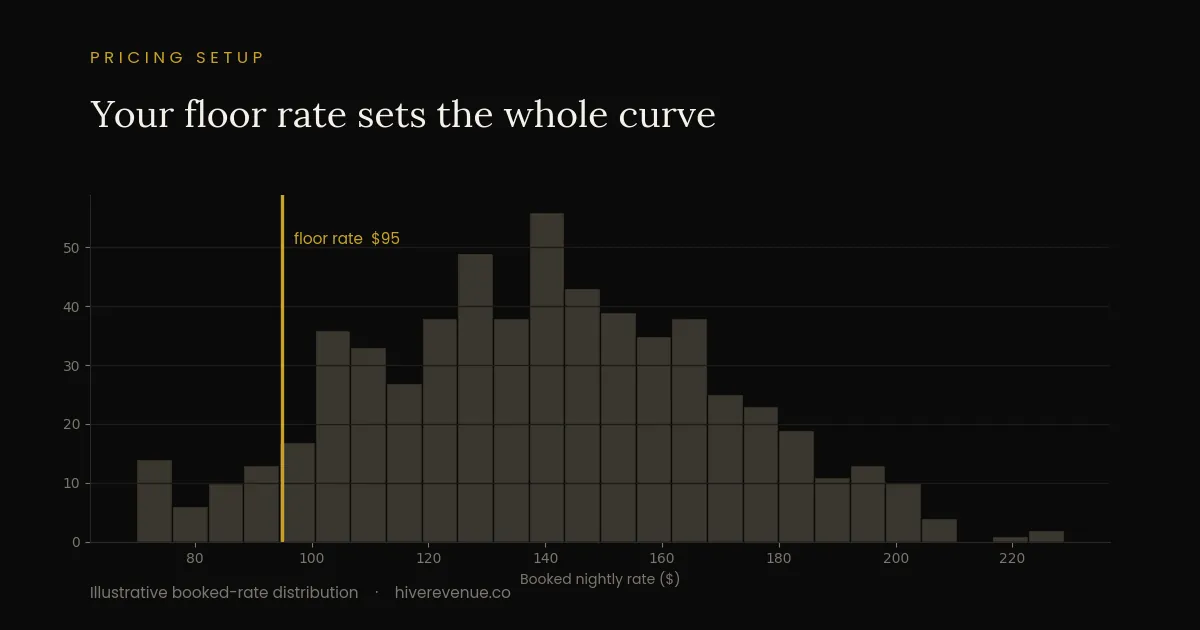
Most operators spend hours debating which dynamic pricing tool to use. PriceLabs versus Wheelhouse versus Beyond. They tune their seasonality curves and obsess over last-minute discount settings. Then they type a floor rate in without thinking, and quietly destroy their own revenue floor for the entire year.
The floor rate is the single most consequential number in your pricing setup. Not your base price. Not your weekend lift. The floor. Because it is the number that defines the absolute worst outcome for every open night on your calendar, and most people set it based on a feeling rather than a calculation.
If you have gotten this wrong, which most operators have, you are not just leaving money on the table. You are actively subsidizing guests during your weakest demand windows.
What the Floor Rate Actually Does
In PriceLabs, Wheelhouse, and Beyond Pricing, the floor rate acts as a hard lower bound. The algorithm will not go below it regardless of how far out the dates are or how soft demand looks. It is the ceiling on how badly the tool can hurt you.
The problem is that most operators treat it as a psychological safety net rather than a financial calculation. They set it at some round number that feels reasonable. Sixty euros. A hundred dollars. Whatever the property was renting for on Craigslist in 2019. That number has no relationship to the actual cost of hosting a guest.
A floor rate that sits below your true variable cost per booking is not a floor. It is a trap. You are paying to be occupied.
How to Calculate a Real Floor Rate
Start with your variable cost per booking. This is every expense that only occurs when a guest arrives. Cleaning fee net of what you charge, linen replacement, consumables, channel commission, payment processing, guest damage amortized over time. If you are on Airbnb at thirteen percent and your cleaner costs eighty euros per turn, you already have a hard floor before a single night of accommodation revenue is counted.
Then layer in your fixed cost contribution. Your mortgage or rent, insurance, property management software like Lodgify or Hostaway, Key Data subscription, utilities base load. Divide annual fixed costs by your realistic occupied nights. Not your target. Your realistic number based on historical occupancy in your market. That per-night contribution is what a booking needs to cover before you are making any real return.
Add those two numbers together. That is your true break-even night rate. Your floor should sit at or above that number. Never below it.
A Concrete Example
Take a two-bedroom apartment in the Eixample in Barcelona. Fixed costs annualized come to roughly twenty-two thousand euros. At one hundred and sixty occupied nights, that is one hundred and thirty-seven euros per night in fixed cost contribution. Variable costs per booking, cleaning net of fees plus commission plus consumables, add another sixty euros. True break-even is around one hundred and ninety-seven euros per night.
I regularly audit portfolios where that same property has a floor of ninety or one hundred and ten euros set in PriceLabs. The operator saw it fill up during low season and thought the strategy was working. It was not working. It was burning money with a perfect occupancy rate.
The Spain market in particular rewards operators who hold rates during low-demand windows. January and February in Barcelona are weak. But they are not so weak that holding at a real floor hurts you. Capitulating to the algorithm at ninety euros hurts you. You can read more about how that plays out across the Spanish coastal and urban markets in the Spain STR market 2026 breakdown.
The Cost of Getting It Wrong
There are two failure modes. Setting the floor too low and setting it too high. Most operators suffer from the first, but the second is worth addressing because it is how people overcorrect.
A floor that is too low means your tool will compress rates aggressively as checkout approaches for unbooked dates. PriceLabs, left to its own logic with an orphan gap setting and a low floor, will drop a three-night gap in Ibiza in April to a level that attracts guests who would not otherwise come. That sounds fine until you factor in cleaning costs, the risk of damage at low rates, and the opportunity cost of filling those nights before a higher-demand weekend.
A floor that is too high causes a different problem. Dates go unbooked even at the margin, your occupancy falls below the level that sustains your fixed cost model, and you end up worse off than if you had accepted a below-ideal rate on nights that would never have filled at a premium. There is a zone between break-even and optimal that you want the tool operating in. The floor defines the bottom of that zone.
The most common PriceLabs settings that cost operators money almost always include an incorrectly set floor. It is rarely the only problem, but it is usually the most expensive one.
Market-Specific Floors Are Not Optional
A single floor rate across a portfolio is lazy and usually wrong. The break-even cost structure for a rural Tuscan farmhouse is fundamentally different from a city-center apartment in Marrakech or a villa in the Algarve. Cleaning costs alone can vary by a factor of three or four across property types. Channel mix matters too. A property running primarily through direct booking channels at zero commission has a materially lower variable cost floor than one that is Airbnb-dominant.
In Dubai and the Caribbean, where property management costs run higher, the floor calculation gets even more consequential. A Dubai operator with a service charge, cooling fees, and a premium cleaning provider has a variable cost structure that can push break-even above two hundred dollars per night on a modest one-bedroom. A floor of one-fifty feels safe until you do the math.
If you have not done the floor calculation for each property individually in the last twelve months, it is out of date. Costs have moved. Channel mix may have shifted. The number needs to be revisited, not assumed.
Where to Set the Floor in Your Tool
In PriceLabs the minimum price field in the customization panel is your floor. Do not confuse it with the base price. The base price is the anchor the algorithm adjusts from. The minimum price is the hard lower bound. They do different things and too many operators set them to the same value, which breaks the algorithm’s ability to move dynamically in either direction.
In Wheelhouse, the floor sits in the pricing controls as a minimum nightly rate. Wheelhouse’s default recommendations tend to be conservative, which means if you have accepted their suggested minimums you are likely running with a tool-defined floor that has no relationship to your actual cost structure.
Beyond Pricing uses a similar minimum rate field. The behavior across all three tools is functionally the same. Your calculated break-even number goes in that field. Not a round number. Not a guess. The calculated number. A full comparison of how the three tools handle floor logic is in the PriceLabs vs Wheelhouse vs Beyond breakdown for European operators.
The floor rate is one of forty-two variables that determine whether your revenue setup is actually working. If you have not audited the full picture, the 42-point revenue audit framework will show you exactly where the other gaps are sitting.
Calculate Your Real Floor Rate Before Another Night Sells Below Cost
The Hive Method Workbook includes the 42-point revenue audit, a direct booking readiness scorecard, and a 90-day execution plan. Launch price €97. Use code FOUNDING for €47.