I’m based in Madrid. I work with property owners across the globe and I’ve watched the Spanish short-term rental market go through more turbulence in the last 18 months than in the previous decade combined.
Barcelona’s tourist apartment licenses expiring in 2028. Airbnb fined €65 million by the Spanish government. Thousands of listings delisted. New registration requirements, tightening municipal rules, and an increasingly complex regulatory landscape that changes faster than most owners can track.
And yet — for the owners who are positioned correctly, Spain remains one of the most lucrative short-term rental markets in Europe. The demand is real, the ADRs in premium markets are exceptional, and the opportunity for well-run properties to capture disproportionate revenue has never been greater.
The question is whether you’re one of those owners.
The Spanish Market in 2026: What’s Actually Happening
The noise around regulation is real, but it’s not the whole story. What’s happening in Spain right now is a market correction — a shakeout of poorly positioned, over-listed, under-managed properties that were never going to survive long-term anyway.
That shakeout is good news for serious operators. Fewer listings in key markets means less competition for the guests who are still coming — and they are still coming, in significant numbers. Spain received over 94 million international visitors in 2024. The tourism market isn’t shrinking. It’s consolidating.
The owners who will thrive are the ones who understand that the regulatory environment is now part of their revenue strategy, not separate from it.
Three Revenue Mistakes Spanish STR Owners Are Making Right Now
1. Treating regulatory risk as someone else’s problem.
Whether you’re operating under a VUT license in Madrid, a HUT in Catalonia, or a VTRA in the Canary Islands, the regulatory framework you’re operating under directly affects your pricing strategy. The 90-day cap in certain municipalities, the non-renewability of certain license types, the restrictions on key-box check-in in cities like Florence (which is influencing Spanish policy discussions) — all of these affect how you should be pricing your shoulder seasons, your minimum stays, and your direct booking strategy.
I work with owners who are building their revenue strategy around regulatory certainty, not hoping the rules don’t change. That means structuring pricing to maximise revenue within the operating window they actually have.
2. Using national-level data to make micro-market decisions.
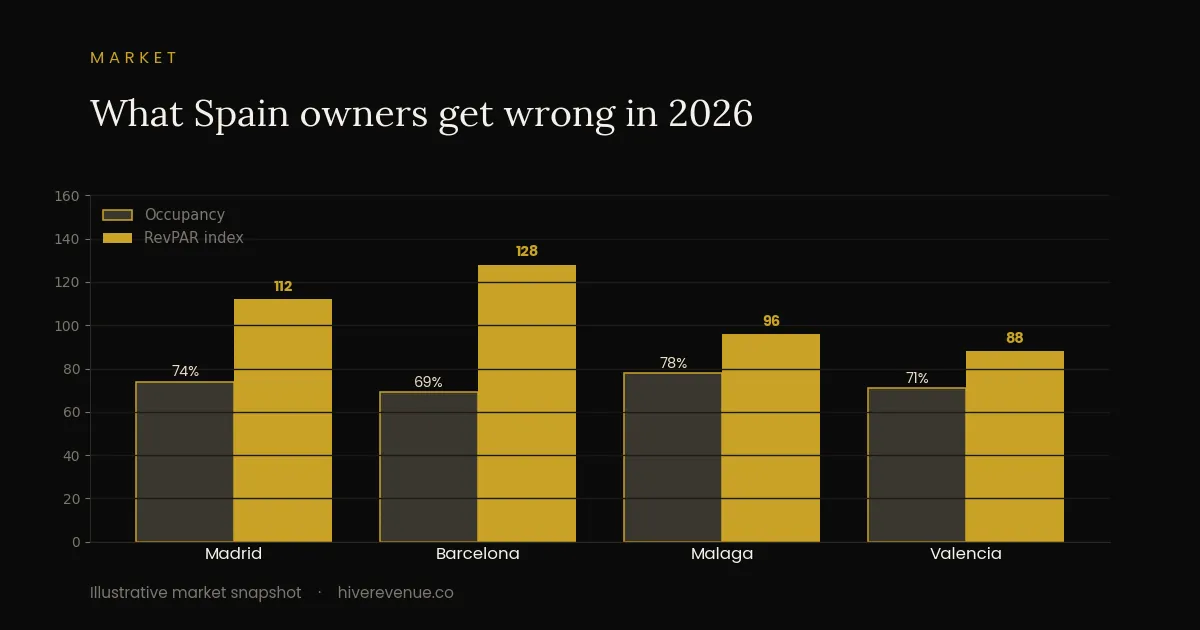
Spain is not one market. Ibiza in July is not the same market as a rural Andalusian finca in November. The Costa del Sol is not the same as the Costa Brava. And yet I regularly see owners benchmarking their performance against national averages, or using comp sets that pull in properties from entirely different sub-markets.
Your comp set should be built around properties that genuinely compete for the same guest you’re targeting. In Spain’s premium leisure markets — Mallorca, Marbella, Formentera, Tarifa — that means being precise about property type, price band, and micro-location. A 6-bedroom villa in Pollença is not competing with a 2-bedroom apartment in Palma. Treating them as comparables will destroy your pricing strategy. For a deeper look at how to configure the right tool for this, see PriceLabs vs Wheelhouse vs Beyond Pricing: Which Is Right for Your European Vacation Rental?
3. Being 100% dependent on Airbnb in a market where that’s increasingly risky.
The €65 million fine Airbnb received from the Spanish government in 2025 was a warning shot. The regulatory relationship between the Spanish government and the major OTAs is adversarial in a way it isn’t in most other European markets. That’s a risk that every owner with a single-channel distribution strategy is carrying.
Direct bookings aren’t just a revenue play in Spain — they’re a risk management strategy. Owners who have built even a 20–30% direct booking base are meaningfully insulated from OTA policy changes, fee increases, and the algorithmic volatility that hits hardest in regulated markets.
What Good Revenue Management Looks Like in Spain Right Now
It means understanding your regulatory window and pricing aggressively within it. It means building a comp set that reflects your actual market, not a national average. It means having a direct booking strategy that reduces your OTA dependence over time. And it means someone watching your pacing weekly, not quarterly — the same discipline I outlined in Why Your PriceLabs Settings Are Losing You Money.
I work with a small number of premium property owners across Spain and the wider European market. If you’re navigating this landscape and not sure whether your revenue strategy is keeping pace with the market, that’s exactly the conversation I’m built for.
Book your free Revenue Leak Audit →
Want to go deeper? The Hive Method Workbook covers the full framework for building a compliant, high-performance STR revenue strategy in regulated European markets. Explore Hive Academy →
Leave a Reply