Most operators set their length of stay discounts once and never touch them again. They pick a number that feels generous enough to attract bookings and assume the occupancy gains will cover whatever they gave away. They are usually wrong.
LOS discounts are one of the most misunderstood levers in short-term rental revenue management. Used correctly, they shift your mix toward longer, lower-friction bookings that cost less to clean and carry less volatility. Used carelessly, they become a standing invitation for guests to pay 15 percent less than you needed them to.
The problem is almost never the discount itself. It is the math behind it and the conditions under which it fires.
The Calculation Most People Get Wrong
Almost every operator I audit is calculating LOS discounts off gross revenue. They think a 10 percent weekly discount sounds reasonable, so they enter 10 percent into PriceLabs or Wheelhouse and move on. The issue is that they are discounting revenue they have not actually earned yet.
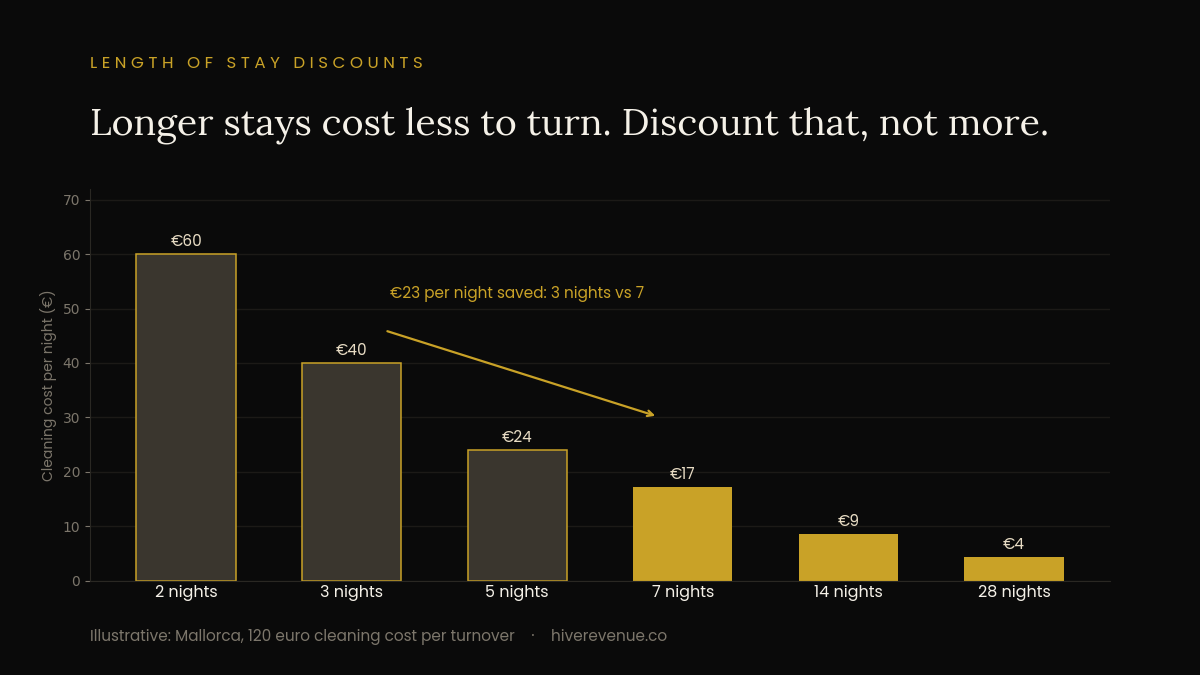
The correct starting point is net revenue per night. Take your nightly rate, subtract your cleaning fee amortized across the stay, subtract your channel commission, and subtract your variable costs like linen service or consumables per night. What remains is the number you are actually discounting against. On a property in Mallorca with a 120 euro cleaning fee on a 3-night stay, your effective net rate could be 30 to 40 euros lower per night than the gross figure suggests. When you apply a 10 percent discount to the gross number, you are eating into margin that simply does not exist.
The cleaner way to think about it: your LOS discount should reflect the cost savings you actually capture from a longer stay, not a number that feels competitive. A 7-night stay eliminates a turnover. A 14-night stay eliminates two. Those are real numbers. Build your discount off those savings, not off a percentage you invented.
If you have not run this calculation for your own portfolio, the 42-point revenue audit walks through exactly how to do it by property type and market.
When LOS Discounts Actually Make Sense
There are specific conditions where LOS discounts earn their place in your pricing strategy. Outside of those conditions, they are a liability.
High-cost turnover markets
In Ibiza and Mallorca during peak summer, cleaning teams are expensive, scarce, and often unreliable. A single turnover can cost 150 to 200 euros all in. If a weekly discount of 8 percent buys you a clean 7-night block instead of two fragmented 3-night stays, you are ahead on net even before you account for the operational stress. That is a legitimate discount. It has a real economic justification.
Shoulder season fill
In the Algarve in October or Tuscany in early November, the market is thin and demand is genuine but price-sensitive. A targeted LOS discount for 5-plus nights can pull bookings from guests who would otherwise book a hotel or skip the trip entirely. This is a demand-creation scenario, not a demand-shifting one. The discount is doing real work here.
Closing orphan gaps
A 2-night gap between two bookings is nearly impossible to fill in most markets. A dynamic LOS discount that activates specifically for stays that close that gap, set through PriceLabs gap filling rules, can recover revenue you would otherwise lose completely. This is one of the few places where an automated discount rule genuinely earns money rather than giving it away.
The Scenarios Where They Destroy ADR
Peak season with strong demand is the most common place I see LOS discounts doing real damage. If you are running a villa in Barcelona or a apartment in Marrakech during a festival week, your natural demand will fill 7-night slots at full price. A 10 percent weekly discount in that environment is not improving your occupancy. It is just reducing your revenue by 10 percent on bookings you were going to get anyway.
The Airbnb and Vrbo algorithms will sometimes surface your listing higher because of the discount, which creates the illusion that it is working. What you are actually doing is trading margin for visibility in a period when visibility was not your problem. Check your Spain market data for 2026 and you will see that peak season ADR compression is already a structural issue. You do not need to accelerate it yourself.
The second scenario is set-and-forget discounts that fire regardless of how far out the booking falls. A weekly discount that activates 90 days in advance on a high-demand property is training your best guests to wait for it. You are creating a discount expectation in a segment that did not need one. In markets like Dubai or the Caribbean where early bookers are often the highest-value guests, this is a particularly expensive habit.
Third, and the one I see most in European portfolios running Lodgify or Hostaway with default settings intact: blanket monthly discounts. A 20 percent monthly discount on a property in Catalonia sounds aggressive and smart until you realize it fires in August, when monthly stays are still rare but the guests who do want them would have paid full price. You have just handed away a month of peak revenue to one guest who got lucky.
How to Set Them Up Correctly in PriceLabs
PriceLabs gives you more control here than most operators ever use. The default LOS discount settings in most accounts I audit look like they were set up during onboarding and have not been opened since. That is a problem covered in detail here, but for LOS discounts specifically, the logic should follow a few principles.
First, your discount percentages should be net-justified. If your turnover cost saving for a 7-night stay is 120 euros and your average nightly rate is 200 euros, your maximum justifiable weekly discount is around 8.5 percent. Start there. Do not start from a competitive benchmarking exercise where you look at what other listings are offering and match them. That is a race you cannot win.
Second, gate your discounts by lead time. A weekly discount that fires only when the stay is within 21 days is a fill tool. A weekly discount that fires at 90 days out is a margin giveaway. PriceLabs allows you to condition LOS discounts on how far out the booking date falls. Use it.
Third, turn off LOS discounts entirely during your proven peak demand windows. If you have 3 years of Key Data history showing that your 7-night blocks in July fill at full price, your discount rule should not fire in July. Set date-based exceptions. This is basic hygiene that most portfolios skip entirely.
If you are comparing tools and wondering whether Wheelhouse or Beyond Pricing handle this more intelligently, this breakdown covers the European market differences between all three.
The Direct Booking Angle Nobody Thinks About
If you are building a direct booking channel, LOS discounts are one of the cleanest ways to pass channel commission savings back to guests without positioning yourself on price. A guest who books direct on a 10-night stay does not need a 10 percent discount to feel the value. They need to see that the direct price is meaningfully better than what Airbnb is showing, and a calibrated LOS discount on your direct site, funded partly by the commission you are not paying, is a legitimate mechanism to make that happen.
The key is that the discount lives on your direct channel only and is not replicated on OTAs. Most operators applying LOS discounts apply them uniformly across all channels. That is the opposite of what you want. The direct bookings guide covers the mechanics of this in full.
If you are giving the same LOS discount on Airbnb that you would give a returning direct guest, you are subsidizing a platform that charges you 15 percent for the privilege of doing it.
Stop Discounting Revenue You Have Not Earned
The Hive Method Workbook includes the 42-point revenue audit, a direct booking readiness scorecard, and a 90-day execution plan. Just $45 — built for European STR operators running 1 to 10 properties.