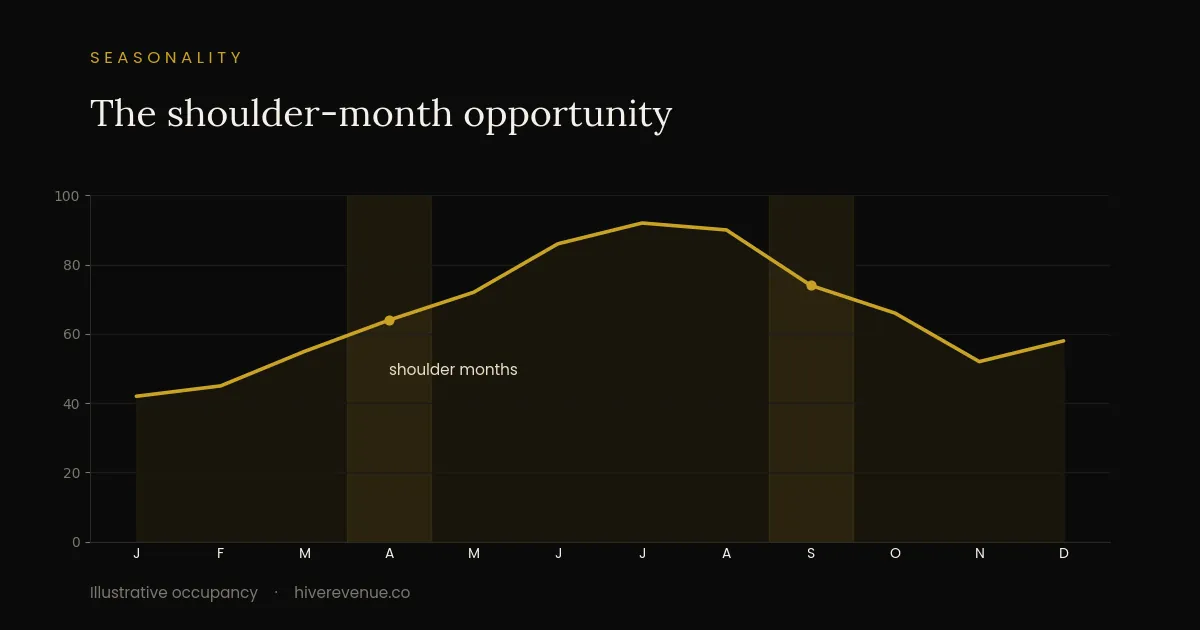
Most Mediterranean operators run peak season well enough to survive, then sleepwalk through shoulder months wondering why their annual numbers are soft. The difference between a 55% and a 72% annual occupancy rate is almost entirely April, May, October, and November.
These months are not dead. They are mismanaged. Mallorca in April is full of German cycling groups, golf tourists, and remote workers who will stay ten to fourteen nights if you price correctly. Tuscany in October has harvest tourism and culinary travelers who will pay more than peak summer families per night. The demand is there. The strategy usually is not.
What follows is how I actually approach these months across a portfolio that includes properties in the Algarve, Ibiza, Barcelona, and the Canaries. It is not theoretical.
Understand What Shoulder Season Actually Means in Your Market
Shoulder season is not a monolith. April in the Algarve is almost high season now, especially post-Easter. May in Ibiza is still dead for most non-villa properties because the club season has not started and the island’s hospitality infrastructure is half-closed. October in Tuscany is warm enough to swim and the crowds are gone. These markets behave completely differently, and copying a strategy from one to another is a fast way to lose money.
Before you touch a single setting in PriceLabs or Wheelhouse, pull your Key Data market report and look at the actual occupancy and ADR curves for your comp set by month. What you think is a shoulder month may have a demand event hiding inside it that your current strategy is ignoring entirely.
If you are operating in Spain specifically, the regulatory environment in 2026 is also reshaping supply curves in ways that affect shoulder month competitiveness more than peak. Fewer new licenses means less competition in the off-peak windows. That is actually an opportunity most operators are not pricing for.
Minimum Stay Strategy Is the Biggest Lever You Are Not Using Correctly
Operators default to a global minimum stay rule and apply it year-round. Three nights minimum, maybe seven in summer. That setting costs real money in shoulder months.
In April and October, the booking window shortens. Travelers are making decisions seven to twenty-one days out, often for shorter trips. A three-night minimum on a property that could be capturing four and five night mid-week stays from couples or remote workers is leaving gaps in the calendar that will never fill. A seven-night minimum in early May for a Mallorca property is essentially telling every non-British traveler to book somewhere else, because that market does not move in weekly blocks outside July and August.
In PriceLabs, use the Custom Date Overrides to drop your minimum stay to two nights for October 1 through November 20, and for April 1 through May 15. Then set a gap-fill rule to allow one or two night stays in the final seven to ten days before arrival whenever a gap of three nights or fewer exists in your calendar. This alone will improve your shoulder occupancy by eight to twelve points in most Mediterranean markets. If you are not using gap-fill logic, start there before anything else.
If you want to understand how min stay interacts with your broader pricing settings, the 42-point revenue audit has a full section on this.
Length-of-Stay Discounts Need to Be Aggressive Enough to Actually Work
A lot of operators have LOS discounts turned on and think they are done. Then they look at their discount structure and it is five percent for seven nights and ten percent for fourteen nights. That is not going to move the needle in shoulder season against properties that are offering fifteen to twenty percent for weekly stays.
The math here is simple. A property at €150 per night with a 15% weekly discount is at €892 for seven nights. The same property with a 5% discount is at €997. For the remote worker or the couple doing a slow travel month in the Algarve or Marrakech, that €105 gap is real. They will take it. And you will take a confirmed seven-night booking over a patchwork of two and three night stays with cleaning costs between each one.
My standard framework for shoulder months: 10% for five nights, 15% for seven nights, 20% for fourteen nights or more. Adjust based on your cleaning fee structure. If your cleaning fee is already €150, the per-night savings matter more and you can be slightly less aggressive on percentage. The goal is to make the longer stay feel obviously correct to the traveler comparing options on Airbnb or VRBO.
If you are running direct bookings, you can push these discounts further without paying OTA commission. A 22% weekly discount that would hurt margin on Airbnb can work fine on a direct booking because you are saving the 15 to 18% OTA cut. This is one of the underused advantages of having a direct channel. The direct bookings guide covers how to structure these offers properly.
Event Stacking Is How You Find Revenue That Is Not in the Seasonality Curve
Shoulder month demand is not just organic leisure travel. It is events, and most operators are only catching the obvious ones. Formula 1 in Barcelona in late April, Semana Santa across Spain, the Volta a Catalunya cycling race, the Feria de Abril in Seville. These are demand spikes sitting inside shoulder months that justify peak-season pricing for five to ten days at a time.
Beyond the obvious, there is a second tier of events that rewards operators who pay attention. Cycling sportives in Mallorca run from February through May and draw thousands of participants from Northern Europe who stay four to seven nights. Golf tournaments in the Algarve happen outside summer deliberately because summer is too hot. Truffle festivals in Provence and wine harvest events in the Priorat and Penedes regions of Catalonia create October demand clusters that show up in Key Data if you know how to read the signal.
The practical approach: build a local event calendar for your market and load the dates into PriceLabs as custom events twelve months out. Raise your minimum stay to three or four nights during those windows, increase your base price by 20 to 35% depending on the scale of the event, and close your early-departure flexibility. Most of your competitors will not have done this until a week before the event, at which point you are already booked.
If you are comparing tools for how each handles event-based pricing, the PriceLabs vs Wheelhouse vs Beyond breakdown is worth reading before you choose where to build this logic.
The Pricing Posture for November and Late October Is Different
November is genuinely slow in most Mediterranean coastal markets. Ibiza is functionally closed. Coastal Mallorca is quiet. Parts of the Algarve see occupancy drop into the thirties. The right answer is not to pretend it is shoulder season and hold rate. The right answer is to be honest about demand and optimize for the guests who are actually in market.
In November, your buyer is a digital nomad, a retiree doing a slow trip, or a couple doing an off-season break. These guests are price-sensitive relative to July travelers but they stay longer, leave better reviews, and are far less likely to party. They are good guests. Price to attract them.
Concretely: drop your base price 25 to 35% below your October rate, drop minimum stay to two nights, turn on your longest LOS discounts, and close your calendar for anything under 60 days out that does not fill in. Do not let the property sit dark at a high rate trying to protect some imaginary ADR number. Revenue per available night is the metric. A €95 per night booking for twelve nights beats an empty calendar waiting for a €140 booking that never comes.
The operators who do this well finish the year 8 to 12 revenue index points above those who do not. That gap compounds. If you have not modeled your November specifically, you are probably carrying assumptions that are costing you several thousand euros per property per year.
Build Your Shoulder Month Strategy With the Hive Method
The Hive Method Workbook includes the 42-point revenue audit, a direct booking readiness scorecard, and a 90-day execution plan. Launch price €97. Use code FOUNDING for €47.