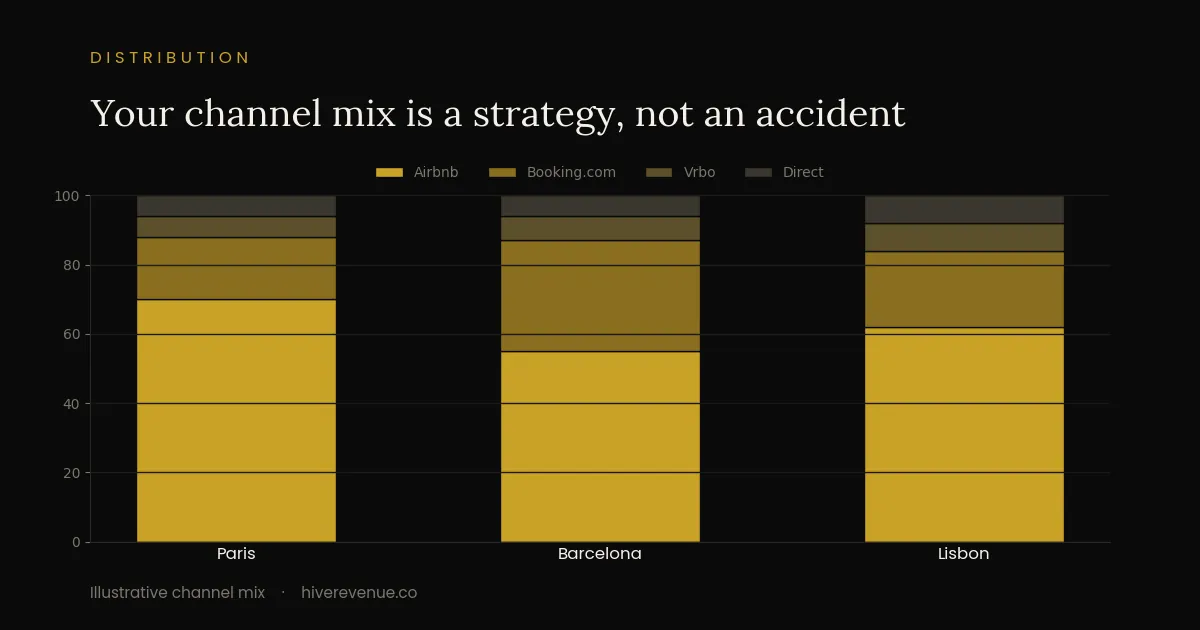
Most operators optimise their pricing and ignore the channel layer entirely. That is a mistake that compounds quietly, year after year, in the form of commissions paid, guest data never captured, and dependency on a platform that can change its algorithm on a Tuesday afternoon.
The question is not which OTA is best. The question is what combination of channels produces the highest net revenue per available night, with the least concentrated risk. Those are different questions and almost nobody is asking the second one.
In European markets specifically, the channel landscape looks different from the US. Booking.com carries real weight. Direct booking infrastructure is more mature. And local OTAs in markets like Mallorca, Tuscany, and the Algarve can move inventory that Airbnb simply does not reach.
The Fee Mathematics Nobody Writes Down
Airbnb charges hosts between 3% and 16% depending on structure. Most operators on the standard split model are paying 3% host-side while guests absorb a 14–16% service fee. That sounds cheap. It is not, because the guest-facing fee suppresses your effective conversion rate and forces you to price lower to stay competitive on total cost.
Booking.com charges 15–18% commission with no guest fee. The math looks worse on the surface, but the guest sees a cleaner total price. That matters in markets like Barcelona and the Costa del Sol where Booking.com drives significant leisure and short-break demand from European travelers who are not habitual Airbnb users.
VRBO sits at roughly 8% host-only commission with an optional subscription model. For operators with higher ADR properties in Ibiza, Tuscany, or the Algarve, VRBO can be quietly excellent. The platform skews toward families booking longer stays, which means lower turnover cost per booking and better net margins even before accounting for the lower commission rate.
Direct bookings, when done properly, cost you 2–5% in payment processing and marketing. The 10–15% you recover per booking is not found money. It is money you were already earning that you were handing to a platform. If you have not yet built the infrastructure to capture even 15% of your bookings directly, this guide covers the full direct booking stack for European operators.
Booking.com in Europe Is Not Optional
American operators often treat Booking.com as an afterthought. European operators who do this are leaving meaningful occupancy on the table, particularly outside peak season.
Booking.com’s demand base in Europe is different from Airbnb’s. It skews toward last-minute travelers, European domestic tourists, and corporate short-break bookers. In markets like Marrakech, Dubai, and the Canary Islands, Booking.com is often the dominant platform by volume. The idea that Airbnb has won Europe is simply not true in every segment.
The operational challenge with Booking.com is that their extranet is clunky, their rate parity enforcement is aggressive, and their cancellation policy defaults are guest-friendly to a fault. You need a proper channel manager, whether that is Hostaway, Lodgify, or something comparable, to run Booking.com without creating calendar conflicts and rate inconsistencies.
The pricing relationship between Booking.com and Airbnb also requires attention. Because Booking.com charges higher commission, many operators simply load the same rate across channels. That is wrong. Your Booking.com rate should account for the commission differential so your net revenue per booking is comparable across channels. PriceLabs now handles this reasonably well through their channel-specific adjustment settings. If you are not using them, there are likely several other settings you are also missing.
How to Think About Channel Diversification
Diversification for its own sake is not a strategy. Adding five OTAs to a poorly performing listing does not fix the listing. It creates operational complexity and usually results in your best inventory going to the channel with the worst terms because that is where last-minute gaps fill.
The right framework starts with your demand profile. Who is actually booking you, and where are they coming from? A villa in rural Tuscany with 80% of bookings from German and Dutch travelers has a very different channel answer than a Barcelona apartment capturing urban demand from across Europe and beyond. The Spanish market specifically has enough regional nuance to warrant its own analysis.
Once you understand your demand base, you build your channel stack in tiers. Your primary channel is wherever your conversion rate is highest and your acquisition cost is manageable. Your secondary channels fill gaps, particularly shoulder season and last-minute inventory. Your direct channel is your long-term margin play, built through repeat guests, email capture, and a property website that actually converts.
Key Data is useful here if you have access to market-level channel data. Seeing what percentage of demand in your market flows through each platform changes how you prioritise your channel investment. Most operators are guessing. You should not be guessing.
The Tools Layer
Channel management without the right tools is a full-time operational burden. If you are managing more than two or three listings across multiple channels manually, you are either making mistakes or burning hours you could spend on revenue strategy.
Hostaway and Lodgify are both solid channel managers for operators in this space. Hostaway tends to suit operators running larger portfolios with more complex team structures. Lodgify is often the better fit for independent operators running five to twenty properties who need a cleaner interface and a built-in direct booking website. The direct booking website component of Lodgify is genuinely good and often underused.
For pricing, PriceLabs remains the most flexible tool for operators who want granular control over channel-specific rates, minimum stay rules by channel, and occupancy-based adjustments. Wheelhouse and Beyond Pricing are both reasonable alternatives with different algorithmic approaches. A full comparison of all three across European market conditions is here.
Boom deserves a mention as a revenue management layer that sits above your dynamic pricer and adds predictive logic. It is not right for every operator, but for those running higher ADR inventory in competitive markets, the additional sophistication can justify the cost.
What a Healthy Channel Mix Actually Looks Like
There is no single right answer, but there are patterns that show up consistently in well-run portfolios. Operators with strong direct booking programs typically run 20–35% of annual revenue through direct channels. Airbnb represents 40–55% of total bookings by volume. Booking.com fills the gaps, particularly in shoulder season and for shorter stays. VRBO contributes meaningfully for higher-end rural and coastal properties where family demand is strong.
What you almost never see in a healthy portfolio is 90% Airbnb dependency. That is not a channel strategy. That is a single point of failure dressed up as simplicity.
The 42-point revenue audit includes a channel mix diagnostic that maps your current channel distribution against benchmarks for your property type and market. Most operators who run through it discover their channel exposure is more concentrated than they thought, and their net revenue per booking varies more across channels than it should.
If you have not run the numbers on what each channel is actually netting you after commission, payment fees, and operational cost per booking, you do not yet have a channel strategy. You have a booking calendar.
Know Exactly What Each Channel Is Worth to You
The Hive Method Workbook includes the 42-point revenue audit, a direct booking readiness scorecard, and a 90-day execution plan. Just $45 — built for European STR operators running 1 to 10 properties.