Most homeowner reports are a liability dressed up as communication. They dump raw numbers on an owner who has no context for those numbers, create anxiety about slow periods with no explanation, and then wonder why the owner starts shopping for a new manager.
The report is not an accounting statement. It is the primary artifact of your relationship with that homeowner. It is the thing they look at at 11pm when they are second-guessing whether this whole short-term rental thing was a good idea. Treat it accordingly.
If your report requires the owner to do math, ask questions, or feel confused, you have already lost something. Maybe their trust, maybe eventually their property.
Start With the Narrative, Not the Numbers
Owners do not actually want data. They want confidence. The data is just the evidence you use to build it.
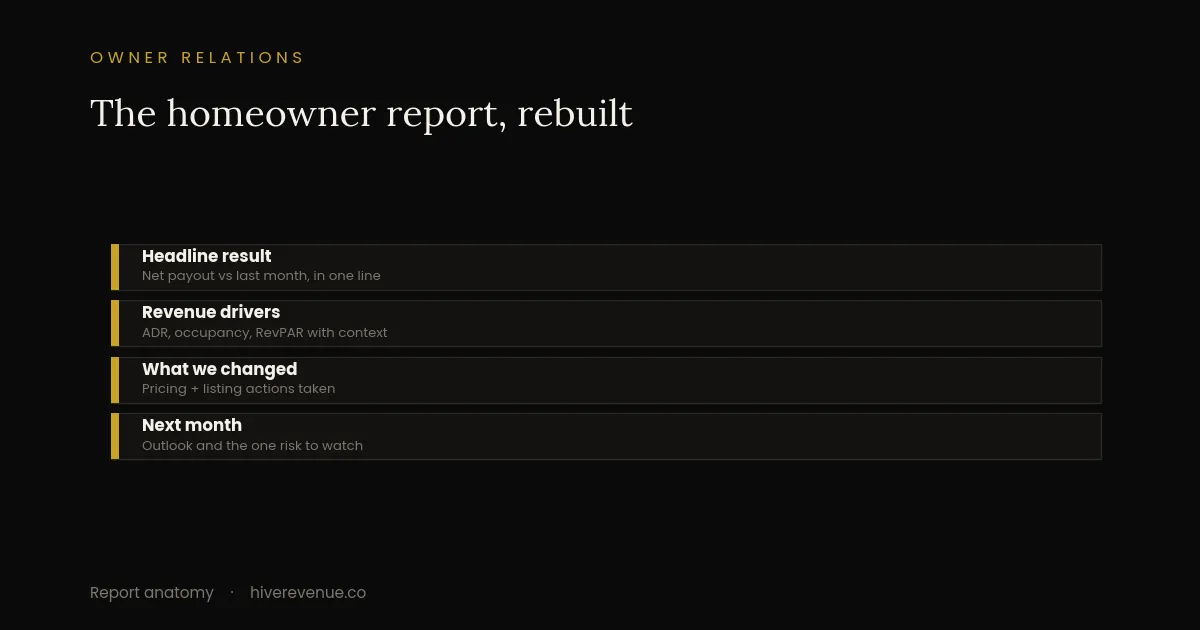
Every report should open with two or three sentences that explain what happened this period in plain language. Not “ADR was €287 and occupancy was 71%.” Something like: “April was a strong shoulder-season month. We held rates through the Easter week surge and your property outperformed comparable units in the area by roughly 12%.” That is the same information, framed as professional judgment.
This is especially true in seasonal markets. If you are managing in Mallorca or the Algarve, April and October look terrible in isolation. Without context, an owner sees a 40% occupancy rate and panics. With context, they see that you intentionally held rates, that demand was thin across the entire market, and that their RevPAR actually beat the competitive set. Those are completely different emotional outcomes from the same underlying data.
Most operators skip this entirely because writing a narrative feels like extra work. It is. It is also the single highest-leverage thing you can do for retention.
The Metrics That Actually Belong in the Report
Include fewer numbers than you think you should. Seriously.
The metrics that belong in a homeowner report are the ones that connect directly to owner outcomes: net payout, occupancy rate, average daily rate, total revenue, and year-over-year or period-over-period comparison. That is the core set. Everything else is context, not headline.
Market comparison data is genuinely valuable when you can source it cleanly. Tools like Key Data or the market dashboards inside PriceLabs give you comp set benchmarks that you can translate into owner-facing language. “Your property ranked in the top third of comparable listings in your area this month” is a sentence that builds trust in your pricing decisions without requiring the owner to understand dynamic pricing mechanics.
What to Leave Out
Channel mix breakdowns, cleaning fee revenue, cancellation counts, review response rates. None of this is meaningful to an owner who is evaluating whether to keep working with you. It creates noise and, worse, it gives them things to ask questions about that will pull the conversation in the wrong direction.
Booking lead time data, length-of-stay averages, and platform fee detail all fall into the same category. Internally, these matter enormously for your pricing strategy. In the owner report, they are distractions. If you have been tuning your PriceLabs settings based on lead time patterns, that is a story you can tell in the narrative. It does not need to be a table in the appendix.
How to Frame Underperformance Without Losing Credibility
This is where most property managers fail. When a month is bad, they either over-explain in a way that sounds defensive, or they under-explain and hope the owner does not notice. Neither works.
The move is to name the underperformance before the owner does, give it a cause, and attach it to a specific action you are taking. “Revenue came in 18% below last June. The market softened earlier than expected across the Barcelona area following the new short-term rental restrictions in Catalonia, and we saw the same pattern across our full portfolio. We have already adjusted the minimum stay settings and tightened the comp set for July pricing.” That is not spin. That is professional context, and it is what operators who actually understand market dynamics sound like.
If you are not tracking market-level context, you cannot have this conversation credibly. That is the real cost of not having proper data infrastructure. The Spain STR market in 2026 has enough structural complexity that operators who cannot explain the why behind the numbers are going to lose owners to competitors who can.
If you cannot explain a bad month in two sentences, you do not understand your own market well enough yet.
Format and Delivery Actually Matter
A PDF attached to an email gets opened once, maybe. A well-formatted email that renders cleanly on mobile, with the three most important numbers visible before the fold, gets read every time. Know your audience. Most of your owners are looking at your report on a phone while doing something else.
If you are using Hostaway or Lodgify, there are built-in owner reporting tools, but they tend to be generic and data-heavy. The operators who use them well treat them as a starting point and customize the narrative layer on top. The operators who use them badly just send the default export and wonder why owners feel uninformed.
Send monthly, at minimum. Send within the first three days of the following month while the period is still recent in the owner’s mind. If something significant happened, like a high-value booking, a rate hold that paid off, or a market event, send a short note in real time. Do not save everything for the monthly report. Touchpoints between reports are what separate managers who feel like partners from managers who feel like vendors.
The Forward Look: What You Are Doing Next
Every report should end with a short section on the coming period. What the demand picture looks like, where you have set pricing, whether there are any gaps you are working to close. This is the part most operators skip entirely, and it is the part that most directly demonstrates active management.
In high-season markets like Ibiza or Tuscany, the forward look section in April and May is the most important thing in the report. Owners know their summer should be strong. If you are not showing them that you have a pricing strategy in place, a minimum stay structure, and a plan for the shoulder weeks around peak, they are going to start wondering what they are paying you for.
This connects directly to the trust case for dynamic pricing. If you have done the work, the tool you chose and how you configured it should be evident in the results. Show the owner that the price curve for peak weeks is set intentionally. Show them the demand trend that supports your rate decisions. Make the work visible.
Owners who can see what you are doing next do not go looking for someone else to do it instead.
If you have been sending the same report template for the last two years and owner questions are still coming in after every send, that is your answer.
Audit Your Revenue Before Your Owners Do It For You
The Hive Method Workbook includes the 42-point revenue audit, a direct booking readiness scorecard, and a 90-day execution plan. Just $45 — built for European STR operators running 1 to 10 properties.