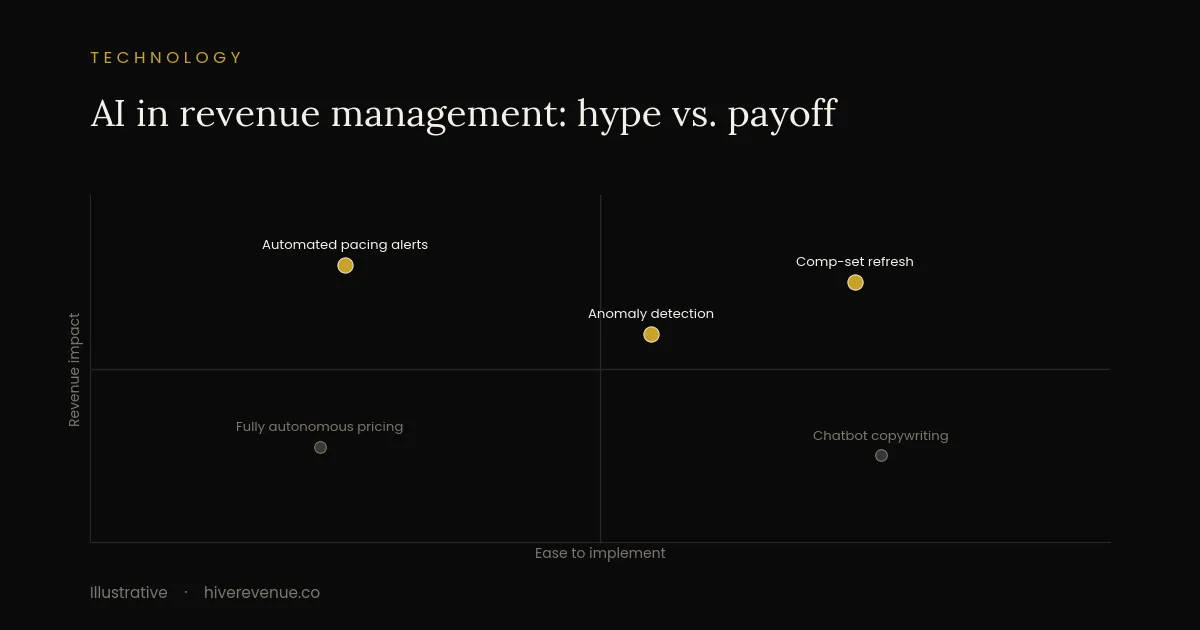
The operators losing the most money right now are not the ones ignoring AI. They are the ones who handed their pricing decisions to it.
There is a version of AI hype that sells short-term rental owners on a fully automated revenue stack where a model reads the market, sets the price, and optimizes yield while you sleep. That version does not exist. What does exist is genuinely useful, but only if you understand what these tools are actually good at.
I run revenue across a portfolio touching properties in Mallorca, Algarve, and Tuscany. I use AI every week. It has not replaced a single judgment call. It has made every judgment call faster and better-informed.
What AI Is Actually Good At
Pattern recognition at scale is the real capability. If you feed a model three months of booking data, competitor rate history from Key Data, and your PriceLabs pickup log, it will surface correlations you would have missed. Not because it is smarter than you. Because it does not get bored.
Report generation is the other genuine win. The difference between a weekly revenue summary that takes forty minutes to write and one that takes eight minutes is Claude. I feed it raw numbers and tell it what I want the narrative to say. It drafts. I correct. The operator gets a clean, readable performance review every Monday morning.
Data synthesis across sources is where it saves the most time. Pulling occupancy trends from your PMS, pacing data from Key Data, and rate benchmarks from Wheelhouse into a single coherent picture used to require building your own spreadsheet infrastructure. Now you paste it into a prompt and ask for the story. The story is usually directionally right.
If you are still writing your weekly performance emails by hand, you have already fallen behind on time that should be going toward actual strategy.
What AI Cannot Do
AI has no feel for a market. It does not know that the Ibiza villa market collapses the week after the last major club closing party, or that Catalonia’s short-term rental license freeze has created a supply vacuum that shifts pricing power dramatically toward existing licensed operators. It knows what you tell it. That is the ceiling.
It cannot make judgment calls under uncertainty. When a new apartment complex opens 400 meters from one of your Barcelona properties and you need to decide whether to hold rate or compress to capture volume during the transition, no AI model gives you a reliable answer. It will give you an answer. That is different.
Relationships are entirely outside its scope. Direct booking conversion, owner trust, the conversation that keeps a property in your portfolio instead of going to a competitor, none of that is a data problem. The operators in Marrakech and Dubai who are building durable books of business are doing it through relationships, not through better prompts.
The tools people are calling AI-powered revenue management, and I include some of the newer features in Beyond Pricing and Wheelhouse here, are mostly regression models with a marketing layer. They are useful. They are not intelligent. Understanding what each tool actually does under the hood changes how much you trust their outputs.
How to Use Claude in a Weekly Revenue Workflow
I use Claude, specifically, because its ability to hold context across a long conversation makes it useful for iterative analysis. You build a session, not a single query.
Monday Morning Pacing Review
I paste in booking pace data for the next 60 days, compare it to the same window from the prior year, and ask Claude to identify where I am ahead of pace, where I am behind, and what the rate variance looks like by market. It produces a structured summary in two minutes. I spend the next ten minutes challenging its interpretation and adjusting.
This is not AI making decisions. This is AI doing the reading so I can do the thinking.
Competitor Rate Analysis
When I pull competitor data from Key Data or run a manual scrape of comparable listings on Airbnb, I feed that into Claude and ask it to tell me where my properties are positioned relative to comp set. I tell it the property type, the market, and any context it needs about upcoming demand drivers. It gives me a structured read. I sanity-check it against what I know the market is actually doing.
The settings-level decisions in PriceLabs still require a human who understands why the defaults exist and when to break them. AI can help you document your logic. It cannot generate the logic.
Owner Reporting
This is the highest-ROI use I have found. I give Claude the month’s performance numbers, a one-paragraph note on market conditions, and a brief on any anomalies. It drafts a clean owner report in a tone that matches the relationship. I edit for accuracy and add anything that requires my direct judgment. The report goes out in a fraction of the time it used to take.
Owners notice when reporting is consistent, clear, and on time. Most property managers are still sending inconsistent, late, and vague summaries. That gap is a retention problem you can close with two hours of prompt setup.
The Audit Question AI Can Help You Answer
One legitimate use of AI in a revenue context is stress-testing your assumptions. Take your current pricing strategy, your minimum stay rules, your seasonal rate bands, and your channel mix, and paste them into Claude. Ask it to challenge your logic. Ask it to find the weakest assumption. It will not always be right, but it will ask questions you stopped asking because you got comfortable.
This pairs well with a structured audit framework. The 42-point revenue audit I use across my portfolio gives AI something specific to interrogate rather than a vague prompt. Specificity is the difference between a useful output and a hallucinated one.
The Spain market in particular has enough regulatory complexity right now that using AI to synthesize policy changes, license availability by municipality, and the downstream supply effects is genuinely useful. The licensing picture in 2026 is not simple, and AI can help you track it if you feed it the right inputs.
The Workflow Principle That Does Not Change
Every AI output is a draft. Treat it that way. The moment you start treating an AI summary as a final read on your market, you have outsourced a function that requires your judgment to a tool that has none.
The operators who will use AI well over the next two years are the ones who already understand revenue management deeply enough to know when the output is wrong. If you do not have that foundation, AI gives you faster access to wrong answers.
Direct bookings, owner relationships, and channel strategy all still depend on things AI cannot provide. Building a direct booking engine in Europe in 2026 requires understanding guest behavior, platform incentives, and trust mechanics that no model has internalized in a way you can rely on.
If your current workflow looks the same as it did in 2024, you are not using the tools available to you. But if your current workflow has AI making calls you used to make yourself, you have a different problem.
Build the Foundation AI Can Actually Work With
The Hive Method Workbook includes the 42-point revenue audit, a direct booking readiness scorecard, and a 90-day execution plan. Just $45 — built for European STR operators running 1 to 10 properties.