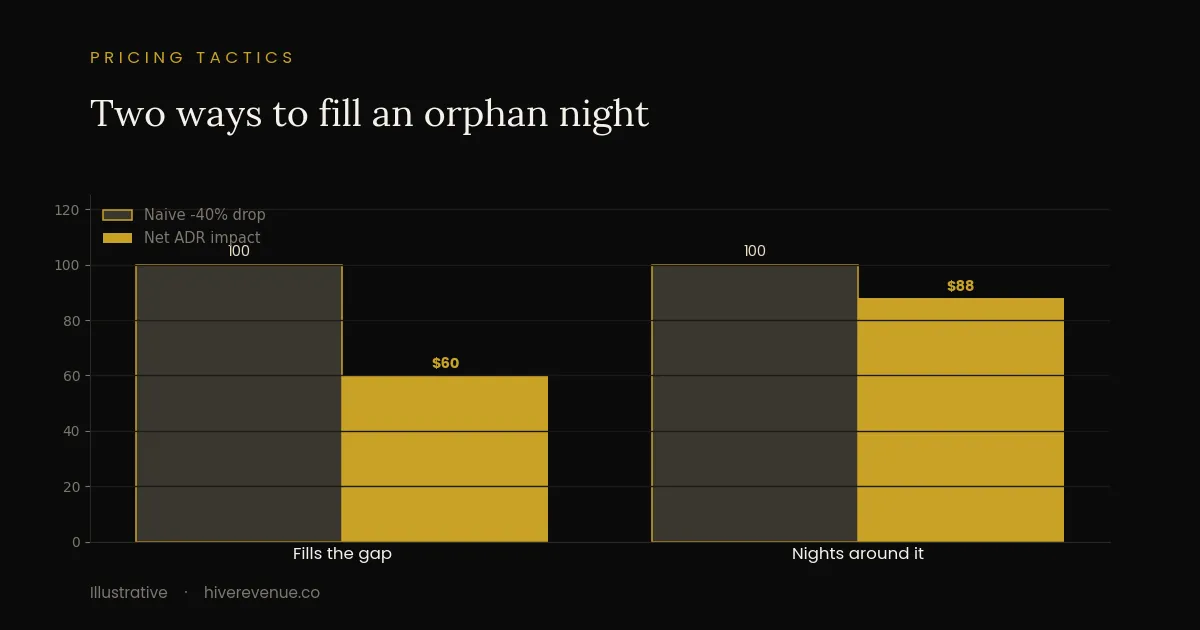
Most operators discover orphan nights the same way. They check their calendar on a Tuesday, see a one or two-night gap sitting between two confirmed reservations, and immediately drop the price by 40 percent. The night fills. They feel good about it. Then they do it again next week, and the week after that.
What they have actually done is build a system that teaches the most price-sensitive guests exactly when to book. And those guests will keep showing up, because you keep rewarding them.
Orphan night management is not a pricing problem first. It is a minimum stay configuration problem that gets solved with pricing second. Getting that order wrong is one of the fastest ways to quietly bleed ADR across an entire season.
What an Orphan Night Actually Costs You
An orphan night is any single or double-night gap that opens between two reservations and cannot be filled at a rate that makes operational sense. The cleaning fee offsets some of the economics, but not all of them. In high-season markets like Mallorca or Ibiza, a one-night gap between two seven-night stays in July is not a revenue opportunity. It is a logistical problem that will probably cost you money if you try to fill it at almost any rate.
The hidden cost is not the gap itself. It is the rate compression that happens when you consistently discount those gaps. Guests in Tuscany, the Algarve, and Barcelona are not unsophisticated. A segment of them tracks listings over time. When your property has a pattern of dropping rates in the seven-to-ten day window before arrival, that pattern becomes a signal. Some of them will deliberately wait for it.
Before you touch your pricing, pull your booking window data in Key Data or from your PMS. If you see a spike in bookings at the seven-day mark specifically on short stays, you have already trained your audience. That is an uncomfortable thing to look at, but you need to look at it.
Minimum Stay Rules Are Your First Line of Defense
The correct approach to orphan nights starts three to six weeks before the gap appears, not two days before. That means your minimum stay configuration has to be dynamic and it has to be intentional.
PriceLabs has a feature called Gap Fill that most operators either ignore or misconfigure. It detects orphan gaps and automatically relaxes the minimum stay to match the gap size. This is useful, but only if your base minimum stay rules are set correctly in the first place. If your default is already two nights, Gap Fill cannot do much for you. The default PriceLabs settings lose most operators money precisely because the minimums are not calibrated to the property’s actual booking patterns.
The rule I use across most of the portfolio I manage: set a three or four night minimum during peak and shoulder seasons, let PriceLabs Gap Fill handle the exceptions, and never manually override a gap price below 85 percent of your base rate unless you are within 48 hours of the stay date. That last threshold matters. There is a meaningful difference between accepting a slightly lower rate close-in and training guests to expect a discount at seven days out.
Orphan Gaps in Different Market Contexts
In a market like Marrakech or Dubai, where average stays are shorter and the guest mix is more international, orphan gaps are a smaller structural problem because the base minimum stay is already lower. The risk there is different: it is aggressive last-minute discounting on nights that would have filled anyway.
In Mediterranean seasonal markets, Catalonia, the Balearics, coastal Portugal, the problem is the opposite. Stays are long. Turnover days are fixed. A one-night gap in peak season is nearly unfillable at a rate that justifies the operational overhead. The correct answer there is often to leave it empty and protect your ADR. That is a sentence most operators are not comfortable reading, but the math supports it more often than you would expect.
The Pricing Logic When You Do Decide to Fill
When you have decided a gap is worth filling, the pricing question is not what rate will attract a booking. It is what rate does not damage the perceived value of your property for the guests already booked on either side of it, and for future guests who will see your pricing history.
A framework that works: start with your standard nightly rate for that date. Apply a gap discount only if the gap has been open for more than fourteen days and you are within ten days of the arrival date. The discount should not exceed 20 percent. If that rate does not attract a booking, accept the vacancy. The alternative, a 40 to 50 percent markdown, might fill the night but it will anchor the guest’s price expectation and it will show up in your performance data in ways that hurt future negotiations with OTAs on ranking and visibility.
If you use Wheelhouse or Beyond Pricing rather than PriceLabs, the gap logic is handled differently. Each tool has a different philosophy on how aggressively to chase last-minute demand, and for orphan nights specifically, the level of manual control matters. Wheelhouse tends to be more aggressive on last-minute discounting, which can help in high-demand urban markets but will hurt you in low-inventory seasonal properties where you have pricing power you should not be giving away.
How to Stop Training Guests to Wait
If you have already created a pattern of last-minute discounting, you cannot fix it in one week. What you can do is start introducing inconsistency into the pattern so that waiting becomes a less reliable strategy for guests.
This means occasionally holding your rate on orphan gaps even when it means the night goes empty. It means using your direct booking channel to offer gap discounts selectively to past guests rather than making them visible to everyone on Airbnb and Booking.com. A guest who gets a private offer through your email list or through a direct booking site built on Lodgify or Hostaway does not affect your public pricing signal. Your direct booking channel is where orphan night strategy and loyalty can actually work together.
It also means being honest about how you got here. If your occupancy rate looks healthy but your ADR has drifted down over two seasons, orphan night discounting is one of the first places to look. A proper revenue audit will surface this faster than most operators expect.
The Test Most Operators Never Run
Take your last twelve months of booking data. Filter for stays of one or two nights. Look at what those guests paid per night compared to your average for the same dates. Then look at when they booked relative to arrival.
If the one and two-night bookings are clustering in the seven-to-fourteen day window and pricing at 20 to 35 percent below your average, you have a documented discounting pattern. The market did not create that pattern. You did, one manual price drop at a time.
The fix is not complicated, but it requires accepting that some nights will go empty. That acceptance is what separates operators who protect their revenue position from operators who are always chasing occupancy at the cost of everything else. Occupancy is a vanity metric when ADR is sliding underneath it.
Stop Discounting Gaps. Start Managing Them.
The Hive Method Workbook includes the 42-point revenue audit, a direct booking readiness scorecard, and a 90-day execution plan. Just $45 — built for European STR operators running 1 to 10 properties.