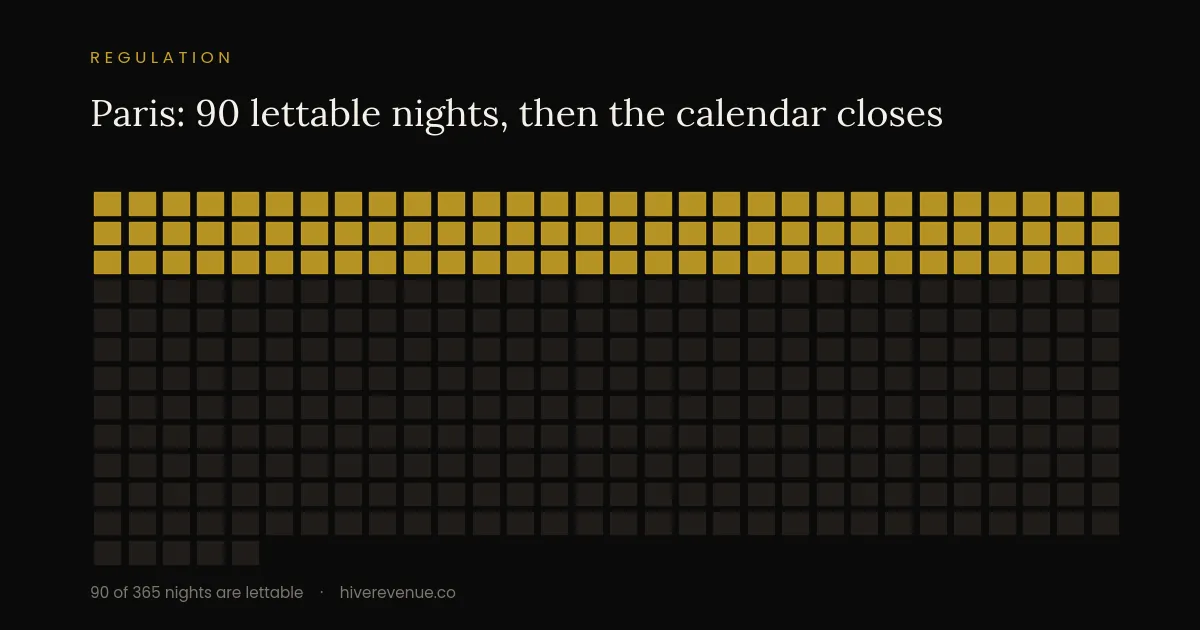
Most STR operators treating Paris like any other market are leaving serious money on the table, and some of them are also breaking the law. The 90-day cap on short-term rentals of primary residences in Paris is not a minor compliance footnote. It is the single most defining constraint on revenue strategy in the French market, and almost nobody is pricing around it correctly.
The cap applies to primary residences in Paris, Lyon, Bordeaux, Nice, and a growing list of French communes that have opted into stricter local enforcement. Secondary residences face different rules, but in Paris specifically, the enforcement environment has sharpened considerably since 2023. Platforms are now required to enforce limits directly, cutting off listings automatically when they cross the threshold.
If you have 90 nights to work with, every pricing decision carries a weight that simply does not exist in uncapped markets. You are not optimizing for annual revenue. You are optimizing for 90-night revenue. That distinction should change everything about how you run your calendar.
What the Cap Actually Does to Your Revenue Math
A standard uncapped property in a city like Lisbon or Barcelona might target 70 to 75 percent annual occupancy across 365 available nights. In Paris under the cap, you have 90 nights. If you hit 85 percent occupancy within those 90 nights, that is 76 booked nights. Your entire annual STR revenue comes from those 76 nights.
That math forces you to be far more aggressive on rate than operators in uncapped markets. The instinct to fill the calendar early at modest rates is the wrong instinct here. You need to think in terms of revenue per available night across a 90-night window, not across 365.
The practical implication: your minimum acceptable rate should be significantly higher than it would be for a comparable property in Marseille or Montpellier where the cap does not apply. If you are running PriceLabs on a Paris property with the same base price and minimum rate settings you would use elsewhere in Europe, you are underpricing. Read more on how default tool settings can quietly erode revenue here.
Choosing Your 90 Nights: Calendar Strategy Matters More Than You Think
Most Paris operators make a passive mistake. They open their calendar broadly, accept bookings as they come in, and exhaust their 90 nights across a mix of high-demand and low-demand dates. By June, they have burned through their cap allocation on a combination of strong spring demand and shoulder-period nights they accepted at weak rates in February.
The smarter approach is deliberate calendar management. Paris has clear demand peaks that any operator with access to Key Data or the market intelligence layer in PriceLabs can identify. Fashion Weeks in January and October. Roland Garros in late May and early June. Bastille Day and the surrounding period. The Paris Marathon. Major trade shows at Porte de Versailles. The Christmas and New Year window.
A disciplined operator identifies the highest-demand 90 nights in the calendar year and targets those windows specifically. This means blocking the calendar during weaker periods, even if you are getting booking inquiries. Accepting a weak booking in early March costs you a high-value night in October. That trade is almost never worth it.
This is not a novel concept in revenue management. It is basic displacement analysis. But very few Paris STR operators are applying it systematically, which means those who do are running significantly higher revenue per available night than their neighbors.
Pricing Tactics Within the Cap Window
When your available inventory is 90 nights, compression in the market hits differently. A sold-out Paris weekend during Roland Garros, with hotels at 95 percent occupancy, should be returning rates that reflect genuine scarcity. If your dynamic pricing tool is applying a 20 percent boost on top of a base rate that was already too conservative, you are still underpriced.
Setting a Floor That Reflects Scarcity
In PriceLabs, your base price and minimum price settings need to account for the fact that you cannot make up for a bad night with volume. For a well-positioned Paris apartment, I would argue your minimum price should be uncomfortable to look at. It should feel like you are asking too much. That discomfort is usually a sign you are in the right range for a constrained inventory situation.
Compare approaches across the major tools in the full tool comparison for European operators. For Paris specifically, PriceLabs gives you the most granular control over event-based customizations, which matters a great deal in a city with this many defined demand spikes.
Last-Minute vs. Lead-Time Pricing
The conventional wisdom in STR pricing is to drop rates as you approach the stay date to fill gaps. In a capped market, this logic inverts. If you have five nights left in your annual allocation and it is November, you should not be discounting to fill them. You should either be pricing those nights at a premium because your supply is genuinely constrained, or blocking them and accepting that you will not use your full 90 nights this year.
Leaving two or three nights unused at the end of the year is not failure. Filling those nights at 60 euros when your average cap-period rate should be 180 euros is the actual failure.
The Direct Booking Case Is Stronger in France Than Almost Anywhere
The 90-day cap applies specifically to short-term rentals on platforms like Airbnb and Vrbo. The enforcement mechanism is platform-level. This creates a structural incentive to understand what falls outside that definition and how direct bookings interact with the regulatory framework, because in many French communes the cap tracks platform nights, not all nights.
I am not advising anyone to circumvent regulation. But understanding the precise legal definition of what constitutes a regulated short-term rental in your commune is basic due diligence. In Paris, the registration and cap system is tied to the platform reporting obligation. If you are running direct bookings through a Lodgify or Hostaway-powered website, the legal picture is different and worth understanding with a French lawyer who specializes in property regulation.
Beyond the regulatory dimension, direct bookings in Paris make financial sense on their own terms. A 15 percent OTA commission on a 200 euro night is 30 euros. Across 76 booked nights, that is 2,280 euros in commissions. For a property where total annual STR revenue might be 15,000 to 25,000 euros, that commission load is significant. The full framework for building a direct booking channel is covered in this guide.
Running a Full Revenue Audit Before You Optimize
Before you change your pricing settings or restructure your calendar, you need a clear baseline. Most Paris operators I talk to do not actually know their revenue per available night across their 90-night window. They know their total annual payout from Airbnb, which is a different and much less useful number.
Pull your booked nights by month for the last two years. Identify your top ten revenue nights and your bottom ten. Look at where you accepted bookings that, with hindsight, displaced better demand. That pattern tells you more about your pricing strategy than any benchmarking tool can. The 42-point revenue audit framework gives you a structured way to run this analysis across your full operation.
The broader French market context, including how Spain’s regulatory trajectory compares to what is happening in France, is worth understanding if you are operating across southern Europe. The Spain 2026 market post covers the regulatory parallels in detail.
If you have been running your Paris property on autopilot with default tool settings and a passive calendar, you have almost certainly been subsidizing your guests’ holidays at your own expense.
Running a Capped Market Property? Start With a Proper Audit.
The Hive Method Workbook includes the 42-point revenue audit, a direct booking readiness scorecard, and a 90-day execution plan. Just $45 — built for European STR operators running 1 to 10 properties.